

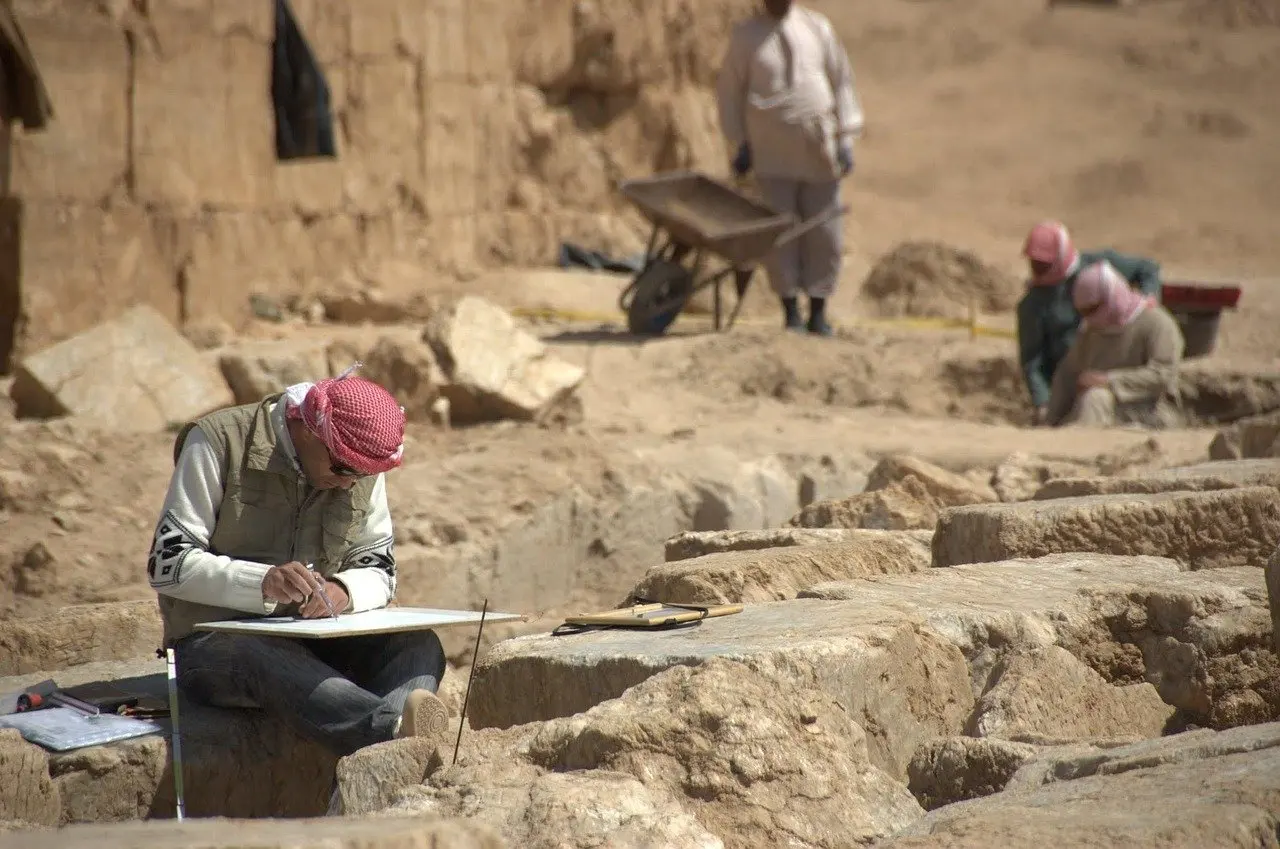
Standing in front of a ruin and asking what is archaeology? It is the scientific study of people in the past and their cultures through the artefacts and sites they left, read in context rather than as loose objects.
That one idea explains most of what follows. Archaeologists dig slowly, record where everything lies, date what they can, and then interpret. If you want the branches of the discipline, read types of archaeology. This page is the orientation: how evidence is found, how it is read, and which sites let you see the results.
Choose your route through archaeology
Readers arrive with different goals, so there is no single correct order. Pick the route that matches what you want to do, then use the later sections as reference.
- You want a clear definition. Start with the section on what archaeology studies. It separates the discipline from ancient history and shows what counts as evidence.
- You want to know what a dig involves. Go to the excavation section. It covers the manual work, the recording habit, and the length and rhythm of a field season.
- You want to understand dates in headlines. Jump to the dating section and its comparison table. It shows which method suits which material, and why some finds cannot be dated directly.
- You want to visit sites. Read the section on reading sites as a visitor, then follow the links to individual places.
- You want to take part. Go to the volunteering section, then to the guide on becoming an archaeologist if you are thinking about a longer path.
If you are new to the subject, the most useful order is definition, then excavation, then dating. Each step gives you vocabulary for the next, and the site-visiting section makes more sense once you know what a layer or a feature is.
What archaeology studies
The United States National Park Service defines archeology as the scientific study of people in the past and their cultures, carried out by analysing their artifacts and sites. The definition has two halves that matter equally. The first is people and their cultures: the questions are about how people lived, not about the objects for their own sake. The second is analysis of artifacts and sites: the evidence is physical, and it is read through method rather than guesswork.
The Park Service also notes that archeology yields perspectives on people and places that cannot be known any other way. That claim is worth taking seriously because it describes what the discipline is for. Written records, where they exist, cover only part of what people did. Objects, buildings and the soil around them record the rest, including the lives of people who never appear in a text.
Not just ancient history
Heritage West Philadelphia puts it plainly: archaeology is not just ancient history; it is the study of the past from the things people left behind. The practical consequence is that the age of the material does not define the field. The method does. Whether the remains are old or comparatively recent, the archaeologist is working from what survives in the ground and on the surface.
The same organisation lists what archaeologists study: architectural features such as house foundations and privy pits, as well as artifacts. This distinction between a feature and an artefact is a useful one to carry into any site visit. An artefact is an object that someone made or used and that can be picked up. A feature is part of the ground or a structure that cannot be lifted out, such as a foundation or a pit. Both are evidence, and both lose most of their meaning if their position is not recorded.
Scale, and why it matters for visitors
The scale of the evidence base is large. The National Park Service reports that it manages over 87,000 archeological sites on park lands and 32 million artifacts held in curatorial facilities. Those figures describe one national agency, not the world, but they make a useful point for planning. Most of what has been excavated sits in storage, not on display, and many sites are protected places rather than staged attractions. A visit to a park or museum shows you a very small, carefully chosen part of the record.
Ideas are also tested away from the trench. Some archaeologists rebuild and use replicas to see whether a proposed way of making or using something actually works; if that appeals, what is experimental archaeology explains the approach and where you can see it in action.
How an excavation works
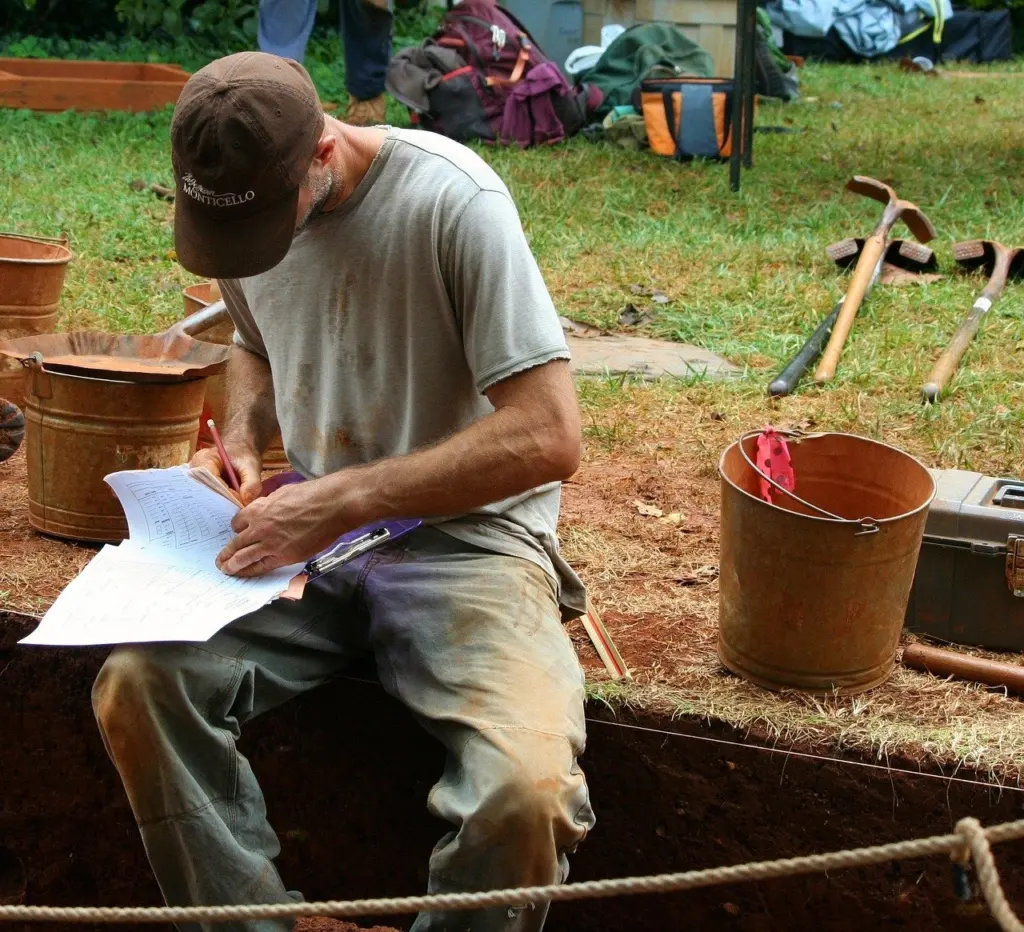
An excavation is a controlled way of taking a site apart so that its history can be recorded as it is removed. The Archaeological Institute of America is direct about the character of the work: archaeology is, first and basically, manual labor. The glamour is in the discoveries; the daily reality is moving soil carefully, often by hand, and writing down what you find.
Context is the main product
Archaeologists dig carefully because they want to know the context of every find. That is the central idea of excavation. An object removed without a record is just an object; an object whose position, neighbours and layer are recorded can answer questions about when, how and why it was left there. This is why a trench looks slow to an observer. The speed is deliberate, and the notes, drawings and measurements are as important as the finds.
The reason context matters so much is stratigraphy. The principle of superposition, as the University of Wisconsin-La Crosse puts it, says that older things are found below younger things. If deposits accumulated in sequence, the order of layers gives the order of events. A coin or a pot in a lower layer was left before something in a higher layer, and an excavator who mixes the layers destroys that sequence for everyone who comes afterwards.
The rhythm of a field season
The AIA describes a single season as lasting anywhere from one week to a couple of months. Work days start early; the AIA says crews usually get up by 5 a.m. Most projects run on a six-day work week. For a visitor or prospective volunteer, these details are a realistic guide to what a dig demands: early starts, repeated physical tasks and little free time in the working weeks.
This is also useful when judging a dig you might join. A short session suits someone testing the experience, and a season lasting up to a couple of months suits someone who can commit and wants to see work progress through several stages. The equipment that makes recording possible is covered in tools archaeologists use, and the career side is in how to become an archaeologist.
From trench to finds tray: working with artefacts
What comes out of the ground is only the start of the analysis. Finds are cleaned, sorted and described, and their recorded context travels with them. The Park Service’s reference to artifacts held in curatorial facilities is a reminder that the long-term job is care: finds must be kept, labelled and accessible for later study.
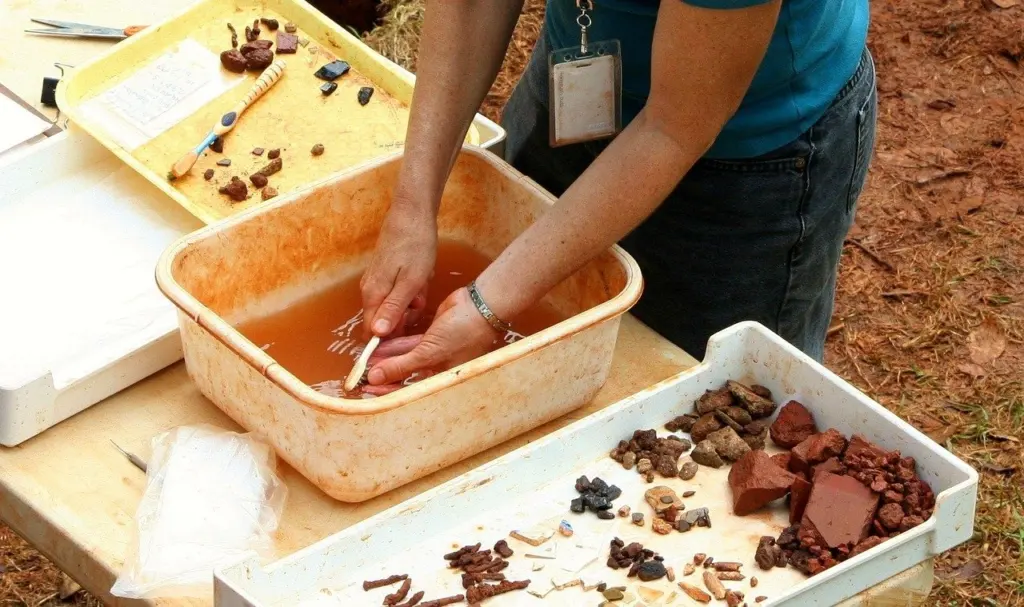
Treating the trench and the lab as one process helps explain why archaeological claims take time. A trench produces records and material; analysis turns them into statements. Reading an artefact well means asking what it is made of, where it lay, what lay with it, and whether anything organic associated with it can be dated. That last question leads directly into the next section, because the material of a find limits how it can be dated.
How archaeologists date finds
Archaeologists use two broad families of dating. Relative dating, according to the University of Wisconsin-La Crosse’s Mississippi Valley Archaeology Center, tells how old something is in relation to other objects, but cannot provide a year. Absolute methods, developed since the 1950s, allow calendar ages to be calculated. The practical skill is knowing which one answers the question you have been asked.
Comparing the main methods
| Method | What it gives | Range and limits | Planning use |
|---|---|---|---|
| Stratigraphy (superposition) | Order of deposits: older layers lie below younger ones | Relative only; no calendar year | Use it to sequence finds within one site before any lab date is sought |
| Relative dating in general | Age in relation to other objects | Cannot provide a year | Fine for “earlier or later” questions, not for a stated date |
| Radiocarbon dating | Calendar age of organic material | Usable back to about 50,000 years; stone tools and pottery cannot be dated directly because they are not organic | Sample organic material linked to the find, not the stone or pottery itself |
| Accelerator mass spectrometry (AMS) radiocarbon | Radiocarbon dates from very small samples | A sample the size of a single kernel of corn can be dated | Suits finds where only a tiny organic sample survives |
| Potassium-argon dating | Dates for sites older than the radiocarbon range | Used for sites older than about 50,000 years, in Europe or Africa for example | Consider it when a site is too old for radiocarbon |
The figures and conditions in this table come from the University of Wisconsin-La Crosse’s dating guide.
Choosing the right method
The table points to a decision rule. Start with the material. If a find is organic, such as something that was once living, radiocarbon dating is a candidate, provided the site is within the range of about 50,000 years. If the find is stone or pottery, radiocarbon cannot date it directly, so archaeologists look for organic material associated with it, such as items found in the same layer. If the site is older than the radiocarbon range, a method such as potassium-argon dating is the alternative.
The AMS point matters for decisions about sampling. Because even a very small sample can now be dated, the lack of a large organic find does not rule out a radiocarbon date. It also means that sampling choices can be careful and small, preserving the rest of the material.
Dating is also a limited resource. The same University of Wisconsin-La Crosse source notes that only about a dozen labs in the United States run radiocarbon samples. In practice, this is why archaeologists select samples with care instead of dating everything they dig up. Stratigraphy does the everyday work of ordering the site, and laboratory dates are used where a calendar age will change the interpretation.
When you read a date in a museum label or news item, ask which of these routes produced it. A statement based only on position in the ground is an order, not a year. A statement with a calendar age should rest on an organic sample or an equivalent absolute method.
Reading famous sites as a visitor
Standing at a site is easier when you know what to look for. Look for layers, if a section is exposed; look for features such as foundations; and ask what has been removed, since most excavated material is no longer where it was found. The records, not the empty trench, carry the evidence, which is why site interpretation panels and museums matter so much to understanding.
Pompeii and the Agora of Athens: long-running excavations
Two cases illustrate how long excavation can run. The AIA notes that excavations at Pompeii began in 1748, and that the excavations in the Agora of ancient Athens have been going on every year since 1931. For a visitor, the lesson is that a site you see today reflects a long history of digging, recording and revisiting. Methods have changed across that time, so the same site can be read differently by different generations of archaeologists.
Pompeii is a good place to practise the feature-versus-artefact distinction on a large scale. Walls, doorways and streets are features that stay where they are; movable finds are mostly elsewhere. If you visit, treat the standing remains as one kind of evidence and the museum displays as another, and try to connect them.
Choosing a site by what you want to learn
Different sites teach different parts of the subject. The guides below each focus on one place, so choose by the question you want answered.
- Burial and ship evidence in Scandinavia. The viking ship museum oslo guide covers the Oseberg and Gokstad burials and how to visit, and the jelling stones denmark guide covers the runestones and mounds at Jelling.
- Monuments and rock art. ales stenar in Sweden is a monument whose age and meaning are the central questions, while the tanum rock carvings show how images carved in rock are read as evidence.
- Settlement archaeology. skara brae is the place to see how a Neolithic village is understood from its remains, and l’anse aux meadows shows how archaeology establishes a Norse presence in North America.
If you are choosing only one, pick on method rather than fame. Skara brae suits you if you want to learn to read buildings, the ship burials suit you if you are drawn to funerary evidence, and the rock carvings suit you if you want to see how a different kind of record is interpreted.
One burial, many kinds of evidence
Sutton Hoo is useful because a single Anglo-Saxon burial site can be approached through different evidence. The Sutton Hoo Sword: Uncovering The Iconic Anglo-Saxon Blade And Its Secrets – Scanheritage looks at one weapon, while The Sutton Hoo Treasure: Inside England’s Most Spectacular Anglo‑Saxon Hoard (2026 Guide) – Scanheritage takes in the wider hoard and The Golden Belt Buckle From Sutton Hoo: Inside The Iconic Anglo‑Saxon Treasure (2026 Guide) – Scanheritage focuses on one object. For the ship that gave the site its fame, Where Is The Sutton Hoo Ship Now? Inside The 2026 Story Of Britain’s Greatest Burial Ship – Scanheritage explains where the story stands now.
Read together, those pages demonstrate the point made earlier: the same site yields a sequence of artefacts, features and interpretations, and each needs its own kind of reading. For a different environment, Irish Bog Bodies: Hidden Lives Unearthed — What These Ancient Burials Reveal About Ireland – Scanheritage covers burials preserved in bogs and what they reveal about Ireland.
Joining a dig as a volunteer
Yes, volunteers can join digs, and this is one of the most direct ways to learn how the evidence is produced. According to the AIA, lots of digs are happy to have student volunteers. The condition to check is cost: some projects charge for room and board, and sometimes tuition. A volunteer place is therefore not always free, and a fee is not necessarily a warning sign, because accommodation and teaching have to be paid for somehow.
How to judge an opportunity
Use three checks before committing. First, match the length to your availability: a field season can run from one week to a couple of months, so a short placement is realistic if you have limited time. Second, expect the working pattern described above, with early starts and a six-day week on most projects, and ask whether the project is explicit about it. Third, ask what you will be taught. A dig that explains why it records context as it does will give you more than one that only needs labour.
A dig suits you if you enjoy repetitive, careful, physical work and want to see how conclusions are built. It is a poor fit if you mainly want to handle exciting objects; most of the day is spent moving soil and keeping records, and finds are the by-product of that process.
When volunteering becomes a career question
A season of volunteering is a low-risk way to find out whether you want to go further. If you do, the routes, qualifications and job types are set out in how to become an archaeologist. Keep the two decisions separate: enjoying a short dig does not commit you to years of study, and the study route is a different kind of commitment from a field season.
Putting it together: a simple way to read any archaeological claim
You now have a working checklist for any site, article or museum label. It takes four questions.
- What was found, and was it an artefact or a feature? Movable objects and fixed structures support different arguments.
- Where was it found? Context and layer decide what an object can tell you.
- How is it dated? Distinguish a relative sequence from a calendar age, and check whether an organic sample could support the date.
- What is the interpretation, and what evidence supports it? Statements about people and their lives are the aim, but they should follow from the first three answers.
Used consistently, these questions turn a visit or a news story into an exercise in reading evidence. That is the real answer to what archaeology is: a disciplined way of getting from soil and objects to claims about people, with the context kept intact at every step.
Frequently asked questions
| Question | Answer |
|---|---|
| Is archaeology the same as ancient history? | No. Heritage West Philadelphia describes archaeology as the study of the past from the things people left behind, which is a method of working from physical remains rather than a specific period. |
| Can school students work on a dig? | The AIA says you can work on a dig even while in high school, and that many digs welcome student volunteers. Check each project for fees and conditions. |
| How much does a radiocarbon date cost? | The University of Wisconsin-La Crosse source states that Carbon 14 and AMS dates cost several hundred dollars each. The source is undated, so check current prices with a laboratory. |
| How long does a PhD in archaeology take? | The AIA says earning a PhD takes from seven to nine years after college. |