

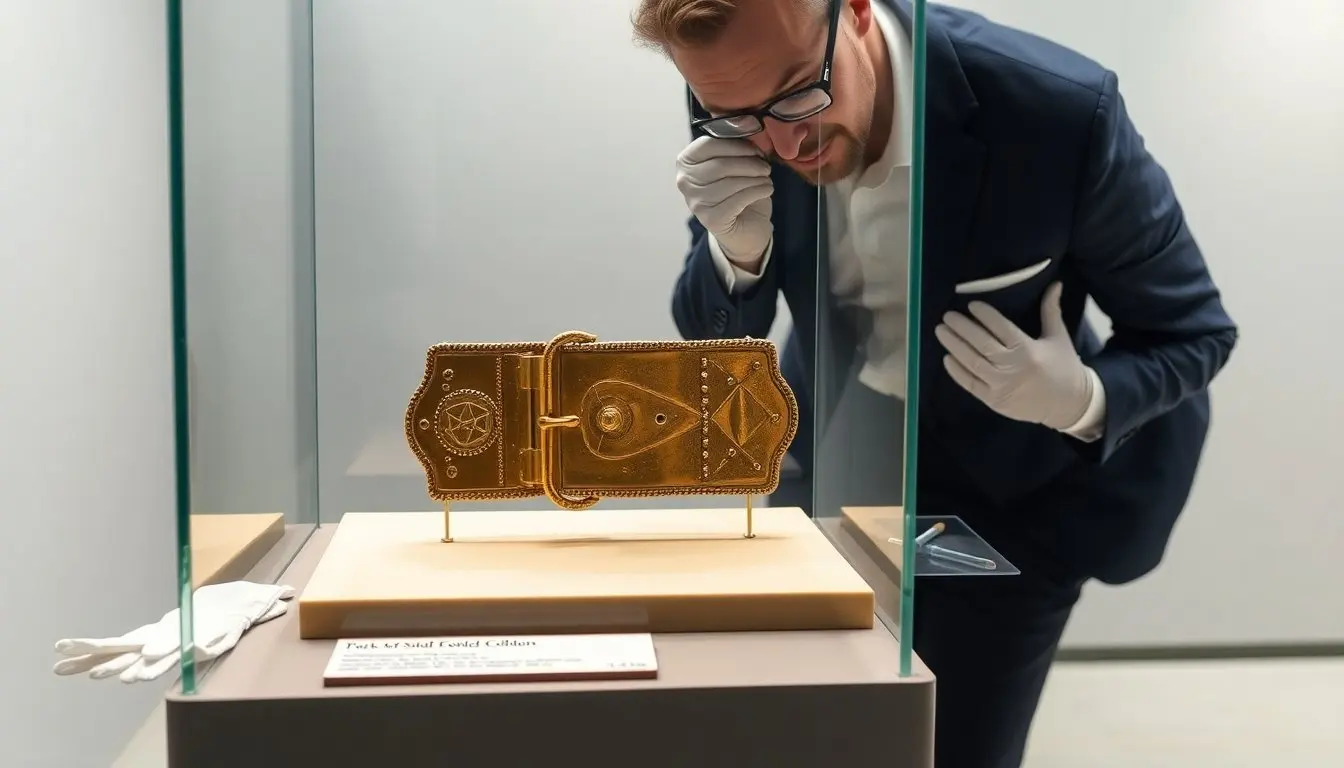
The gold belt buckle from Sutton Hoo appears on lists of the most famous Anglo‑Saxon objects. Archaeologists found the buckle in 1939 in an elite burial near Woodbridge. The object draws study for its craft, imagery, and social meaning. This guide explains who the buried person likely was, what the buckle looks like, how it was made, and why it mattered at the time.
Key Takeaways
- The gold belt buckle from Sutton Hoo is a renowned Anglo-Saxon artifact symbolizing elite status and power in early seventh-century England.
- This buckle features intricate animal motifs and interlaced designs, reflecting northern continental and Scandinavian artistic influences.
- Crafted from high-carat gold sheets over copper cores, the buckle showcases advanced Anglo-Saxon metalworking techniques from skilled workshops.
- Functionally, the buckle served both as a practical fastening and a visible symbol of wealth, rank, and political connections.
- Discovered in 1939, the buckle is now conserved and displayed at the British Museum and the Sutton Hoo visitor gallery with replicas aiding preservation efforts.
- Conservation practices carefully balance preserving original tool marks while protecting the gold belt buckle from corrosion and handling damage.
Sutton Hoo In Context: Who Was Buried And Why It Matters
Sutton Hoo contained a ship burial dated to the early seventh century. The burial included armor, coins, and the gold belt buckle from Sutton Hoo. Scholars link the grave to an East Anglian king or a high noble. They use coin dates, grave goods, and historical records for this link. The object mix implies political ties to Kent and continental Europe. The burial shows elite identity, warrior status, and wide trade links. The buckle stands among other luxury items that mark high rank in early England.
Description Of The Gold Belt Buckle: Form, Size, And Visual Impact
The gold belt buckle from Sutton Hoo measures roughly 10 by 7 centimeters. It appears as a hinged plate with a loop and pin. Craftsmen shaped thin gold sheet over a copper core in places. The surface shows punched decoration, inlay, and niello darkening. Viewers note the bright gold sheen and the strong silhouette. The buckle’s scale made it visible on a worn belt. The piece projected wealth and drew attention at ceremonies and in public settings.
Decorative Motifs, Inscriptions, And Possible Iconography
The buckle carries animal motifs and abstract panels. The motifs include gripping beasts and interlaced patterns. The design echoes northern continental and Scandinavian styles. The buckle shows no long text inscription. Tiny punched marks may record a maker’s sign or workshop mark. Some scholars read the motifs as protective emblems for the wearer. Others treat them as prestige signs that connected the wearer to elite networks. The imagery reinforced rank and identity more than personal biography.
Materials, Techniques, And Evidence Of Workshop Practice
The buckle used high‑carat gold in thin sheets. Craftsmen applied gold over copper or iron cores in some areas. They used hammering, cutting, and chasing to form shapes. They applied solder to join components and punched decoration to add texture. Microscopic study shows tool marks and sequence of steps. The marks match known Anglo‑Saxon and Frankish workshops. The evidence suggests specialists worked in a mobile artisan network. The buckle likely came from a skilled workshop that served elite clients.
Function And Symbolism: Power, Status, And Ritual Use
The buckle served practical and symbolic roles. It closed a belt that held weapons and dress. It marked rank by its rich materials and large size. The buckle functioned as a wearable display of wealth and allegiance. In burial, the buckle signaled the occupant’s social role and authority. It could link the wearer to royal office or a martial identity. The buckle hence operated as a badge, a protective token, and a statement of connections across regions.
Discovery, Conservation, And Where The Buckle Can Be Seen Today
Excavators found the buckle during the 1939 dig led by Basil Brown. Museum curators removed soil and recorded the find in situ. Conservators stabilized loose elements and consolidated fragile joins. The gold belt buckle from Sutton Hoo now forms part of the collection at the British Museum and at the Sutton Hoo visitor gallery in Suffolk on rotation. Curators display high‑resolution images and replicas alongside the original when loans are restricted. Visitors can view contextual objects and read labels that explain dating and analysis.
Conservation Challenges And Modern Display Considerations
Conservators face corrosion where alloys mixed with iron components. They treat salts in burial soil that attack metal joints. They avoid aggressive cleaning to preserve tool marks and surface treatments. Curators control light, humidity, and handling to limit further loss. They document conservation steps in public reports and academic articles. They use 3D scans and replicas to let researchers handle accurate copies. This approach protects the gold belt buckle from Sutton Hoo while keeping it available for study and public view.