

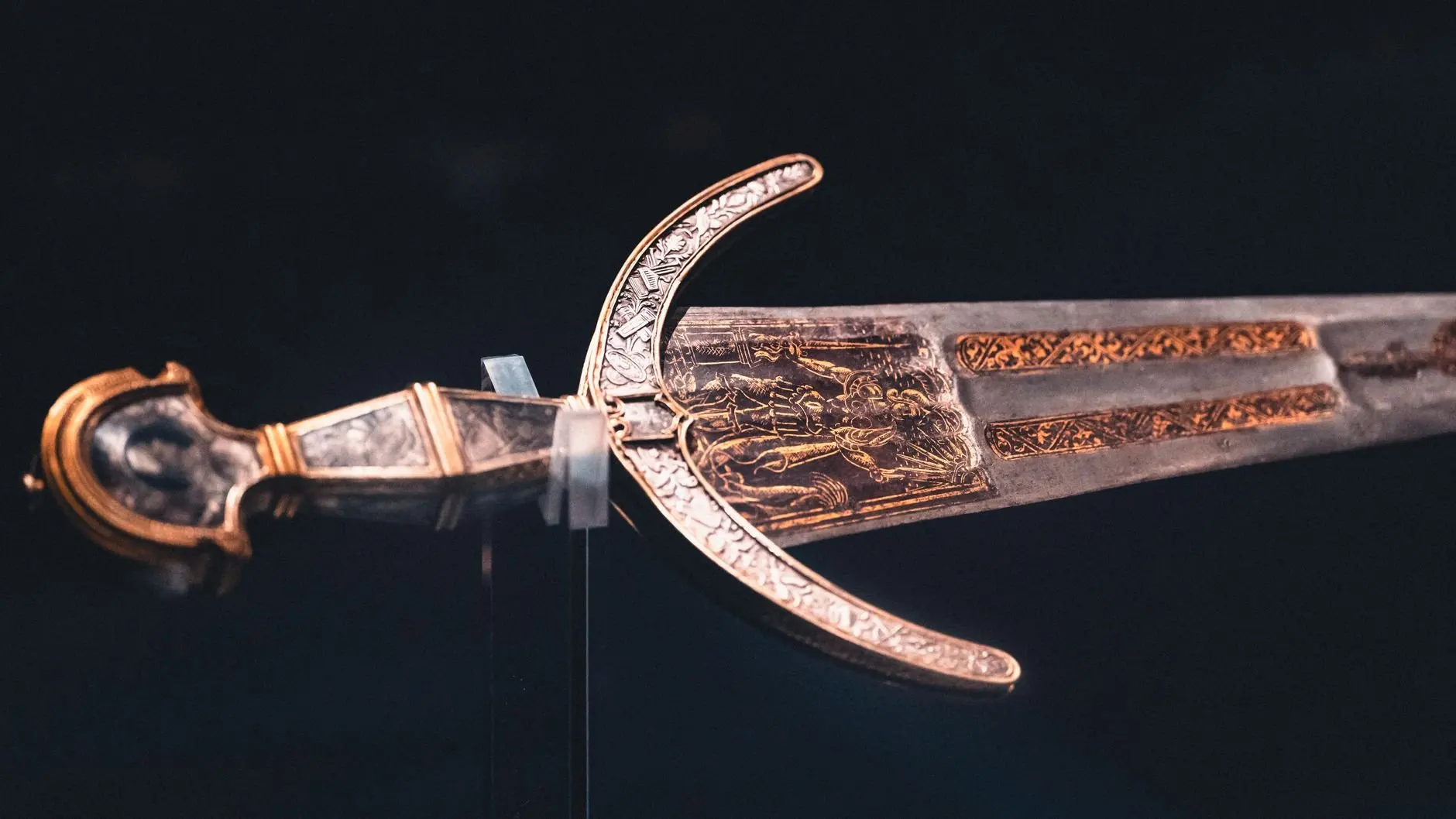
The Sutton Hoo sword is a pattern-welded iron blade with a garnet cloisonné pommel and gold guards, buried in the Sutton Hoo ship burial and now recorded by the British Museum. Coins found in the burial date the monument.
For the discipline behind a find like this, start with what is archaeology. The sections below follow the sword from forge to grave to museum case.
How the blade was built
The blade belongs to the pattern-welded tradition, in which the core is built from twisted iron rather than cut from a single bar. Google Arts & Culture’s description of the British Museum object gives the sequence, which can be read as ordered stages:
- Twist the iron. Rods of iron were twisted together.
- Forge the core. The twisted rods were then forged to form the core of the blade.
- Add the cutting edges. Cutting edges were added to that core.
- Fit the hilt and scabbard. The decorated fittings and a wooden scabbard completed the weapon.
The blade is broad and tapers only slightly towards the tip, according to the museum text reproduced by Sigmart. It survives as a rusted mass. It was not restored from fragments but lifted as a solid. When you look at photographs, you are seeing the original corroded unit rather than a reassembly of loose pieces.
Hilt, belt and scabbard decoration
The decoration sits almost entirely on the fittings. The British Museum record, as presented on Google Arts & Culture, describes these parts:
- Pommel and guards. The pommel is inlaid with garnet cloisonné, and the guards are made from gold plates. This is the most striking area of the sword and the one most often photographed.
- Grip. The grip has two gold mounts decorated with delicate filigree, which adds fine wirework to the hilt.
- Scabbard. The sword was buried in a wooden scabbard bound in leather and lined with sheep wool. The oil in the wool kept the blade bright.
- Belt fittings. All are made of gold with inlaid garnet cloisonné. They include a T-shaped strap distributor built in three moving parts.
The scabbard lining is the practical detail that stands out. The wool was part of how the blade was cared for, so the weapon was maintained as well as displayed.
Museum record and dimensions
The table collects the measurements and record details in one place. Use it to check a label in a gallery or to compare against online catalogue entries.
| Detail | Value | Planning use |
|---|---|---|
| Blade length | 720 mm | Blade only, so do not compare it with overall figures. |
| Overall length | 851 mm, with scabbard and hilt | The figure to use for the sword as buried and displayed. |
| Blade width | 64 mm | Confirms the broad, slightly tapering profile. |
| Date created | 500/650 | A wide range for manufacture, not a burial date. |
| Period and culture | Merovingian; Germanic; Early Anglo-Saxon | Shows the object is catalogued under several traditions. |
| Materials listed | Wood; fur; linen | Shows the record covers organic parts as well as the metalwork. |
| Findspot | Sutton Hoo | Use it to find related objects from the same burial. |
| Registration number | 1939,1010.95.C | The reference to quote when searching the museum catalogue. |
| Acquisition | Donated by Pretty, Edith M | Records how the sword came to the museum. |
Dimensions come from the museum text reproduced by Sigmart, and the catalogue details from the British Museum record on Google Arts & Culture.
Dating the sword and the burial
Two different dates are in play, and they answer different questions. The museum record gives the sword a creation range of its own. That is the window for the object itself. The burial is dated separately: according to a university course chapter on the ship burial, coins allowed numismatists to date the monument to the second quarter of the 7th century.
Do not read the burial date as the date the sword was forged. The record’s wider range leaves room for an object made before it was buried. The coins date the grave, and the catalogue range covers the making of the sword.
The excavations at Sutton Hoo in 1939 were unusual, carried out under the shadow of the impending Second World War, as the museum text notes. The sword came from the ship burial in Mound 1.
The same course chapter reports that coins dated to about 625 led scholars to propose Raedwald, an East Anglian king who died about 624 or 625, as the person commemorated. Treat that as a reasoned identification built on coin evidence, not a name written on the sword.
What the sword suggests about its owner and early rulers
Two details make the owner feel closer than a catalogue entry usually allows. First, worn patches on the pommel were probably caused by the owner’s hand or clothing, per the British Museum description. That points to a weapon handled in life rather than made only for the grave. Second, the belt buckle lay beneath the blade and was crushed when the burial chamber collapsed. It is the only item of jewellery that was damaged.
Gold plates, filigree and garnet cloisonné on nearly every part of the hilt and belt point to an owner of the highest status. A ruler’s sword in this setting was a display of wealth and craft skill, and it was also a personal object that wore with use. That fits the proposal that the burial commemorated a king.
Conservation and where the sword is now
The British Museum record lists the sword as donated by Edith M Pretty. The scabbard was lined with sheep wool, and that oil kept the blade bright. The blade was lifted as a solid, rusted unit rather than restored from fragments.
For display, the British Museum’s own record shows a modern replica of the blade, made by Scott Lankton from X-rays of the original sword, with its location given as the British Museum, London. The replica shows how the blade was shaped without handling the fragile original. If you plan a visit, check the museum’s current gallery information first to see which items are on show, and quote the registration number above when you ask.
Related reading
Burial evidence is read very differently in other settings. Irish Bog Bodies: Hidden Lives Unearthed — What These Ancient Burials Reveal About Ireland – Scanheritage shows how preservation conditions shape what archaeologists can say. For a site from the Norse world, see l’anse aux meadows.
Frequently asked questions
Was a body found in the Sutton Hoo ship burial?
No bones were found, and that absence has led archaeologists to identify the monument as a cenotaph, according to the university course chapter. The monument took the form of a long boat measuring approximately 86 feet.
Was Raedwald a Christian?
Bede identifies Raedwald as the first East Anglian king to be admitted to Christianity, in Kent, though he later reverted to pagan worship, as the same chapter reports. Two spoons inscribed Saul and Paul, apparently christening spoons, were found in the burial.
How highly is the Sutton Hoo metalwork rated?
The course chapter describes the treasure as some of the finest pieces of barbarian metalwork that have come down to us.