

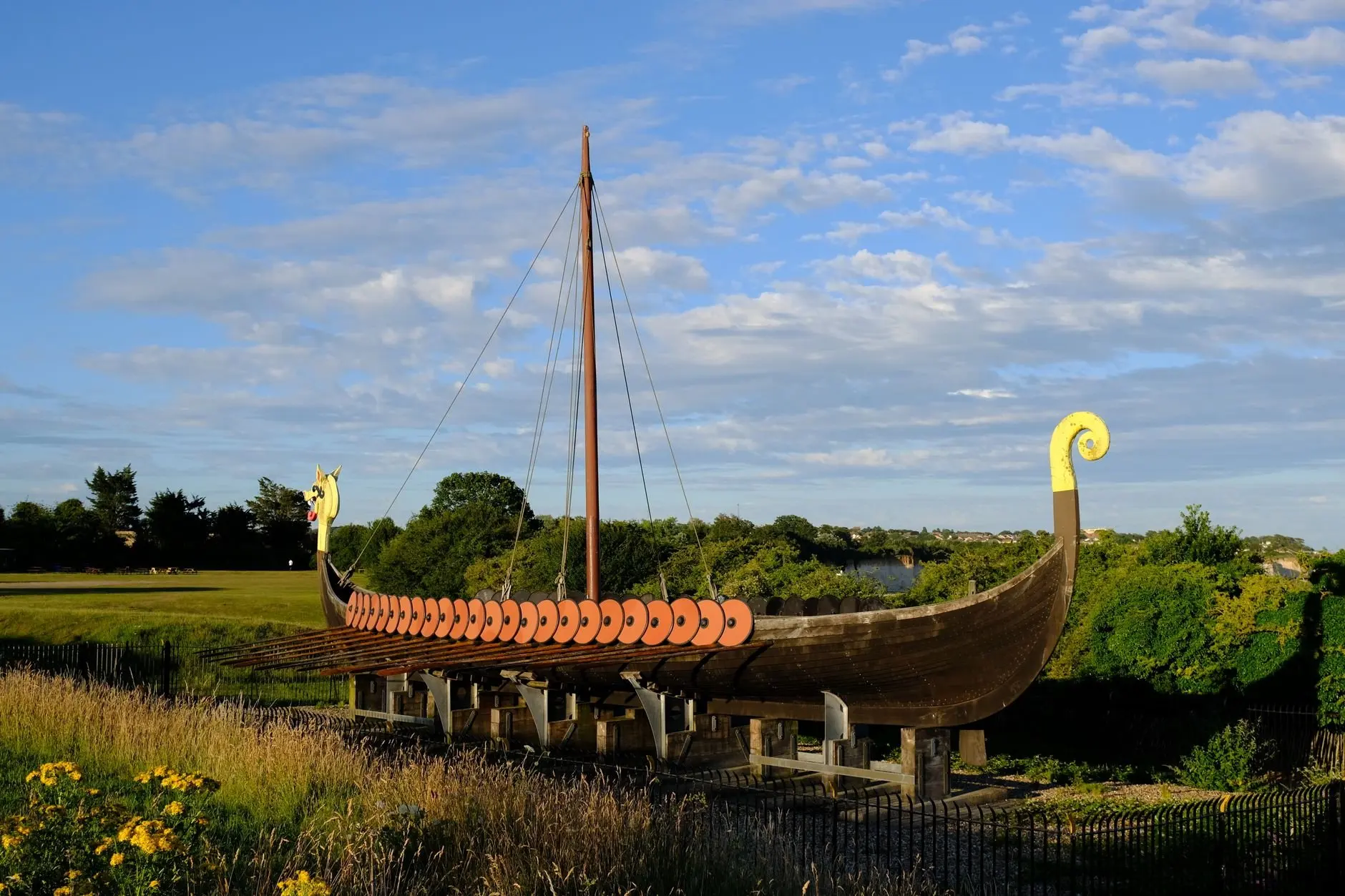
Viking long ships were clinker-built hulls of overlapping planks, driven by sail and oars and steered with a side oar. The Oseberg ship in Oslo is the clearest surviving example to see in person.
Most of what follows rests on excavated ships and museum project records. If you want to know how historians rank that kind of evidence, start with what are primary sources in history.
How Viking longships were built
A longship was a shell of overlapping planks, held together with iron nails, that carried a mast and sail and could also be rowed. Each part of that description reflects a design choice, and the surviving ships show how the parts worked together.
The clinker hull
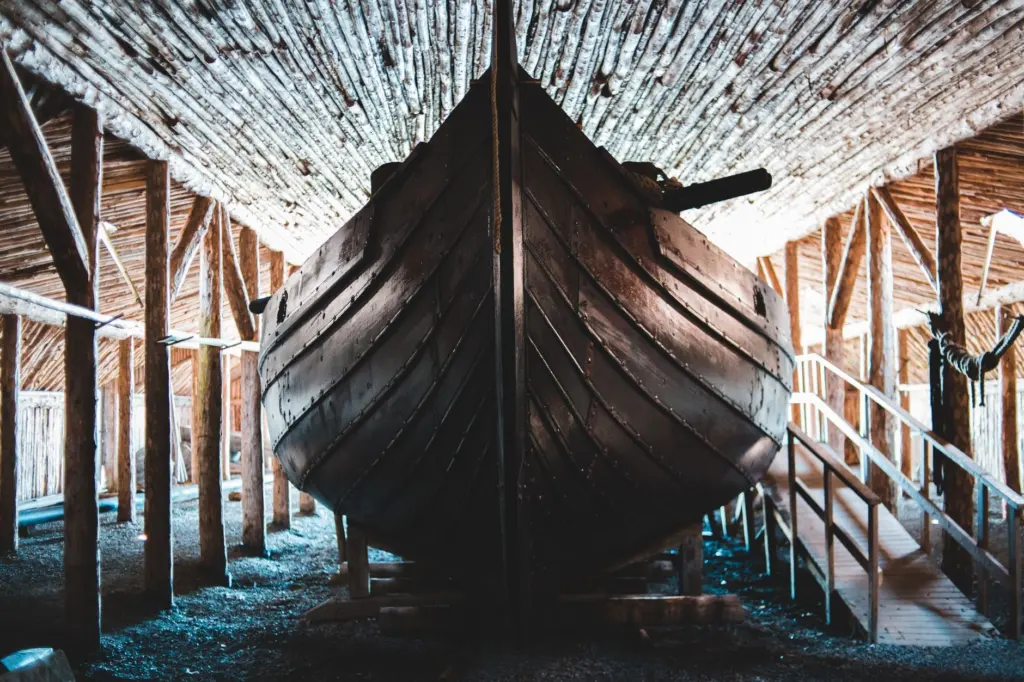
Viking hulls were clinker-built: the overlapping side planks, called strakes, were fixed together with iron clinker nails. Clinker construction differs from building a hull with planks laid edge to edge. Each strake sits partly over the one below it, so the finished side has visible stepped ridges running the length of the ship.
The practical result is a hull with some give. The same account notes that Viking ships flex and bend with the waves rather than resisting them rigidly. A stiff, rigid hull takes the full force of a sea, whereas a shell of overlapped, nailed planks can move slightly with it. That is the main reason clinker construction matters when you judge how a longship could handle open water.
Mast, keelson and sail
The Gokstad ship burial is the best place to study the spine of the vessel. A large portion of the mast and keelson was preserved there. Masts and keelsons rarely survive burial, so Gokstad is the ship to look at when you want evidence for how the rig sat in the hull rather than a modern guess.
Sail area is an estimate rather than a measurement. On a larger Viking ship it could be well over 100 square meters, a figure drawn from preserved fittings and depictions. Treat it as an order of magnitude for the biggest ships, not as a standard size for every longship.
Steering oar and rowing positions
Viking ships had no rudder at the back. They were steered with an oar on the starboard side. If you picture a longship, picture the helmsman working that side oar, not a stern-mounted rudder as on later ships.
Sail was not the only source of power. All Viking ships could be rowed as well as sailed. The largest Viking ship discovered, Roskilde 6, has up to 80 rowing positions. That tells you that the biggest ships were designed around crews, not only wind.
Surviving ships at a glance
Three names recur in any discussion of longship evidence. The table below sets out what is verified for each, and what each is most useful for when you are deciding which ship to study or visit.
| Ship | Verified detail | Planning use |
|---|---|---|
| Oseberg ship | Built in AD 820; buried in a grave mound 14 years later; excavated in 1904; 21.5 m long and 5.0 m wide; exhibited at the Viking Ship Museum, Bygdøy, Oslo | Best single ship for seeing a near-complete hull, and the one to visit first |
| Gokstad ship | A large portion of the mast and keelson was preserved in the ship burial | Key evidence for how the mast and keelson fit the hull |
| Roskilde 6 | Largest Viking ship discovered; up to 80 rowing positions | Shows how large a rowed warship-class crew could become |
Dates and Oseberg dimensions come from the Roskilde Viking Ship Museum’s Oseberg project page, while the Gokstad and Roskilde 6 details come from the World Tree Project’s ship features exhibit.
The Skuldelev ships are often grouped with these finds, but no verified dimensions or dates for them are given here, so check the museum’s own material before quoting any figures.
Speed, heel and the limits of reconstruction tests
Speed is the hardest longship question to answer, because no surviving timber records how fast a ship went. Evidence comes from reconstructions and tests, and those need careful reading.
The most useful record is the Roskilde Viking Ship Museum’s account of its Oseberg reconstruction work. The 1987 reconstruction, Dronningen, sank during its very first sea trial, which took place in windy conditions at a speed of 8-10 knots. The record adds that bow water was shipped over the sheer strake at approximately 9 knots, with a heel angle of about 10 degrees.
Read that number with its conditions. The 8-10 knots is the speed at which one reconstruction got into difficulty in wind. It is not a typical cruising speed, a historical record or a maximum for the original ship. A sailor choosing a replica to learn from should note that a single reconstruction’s trial says as much about the reconstruction as about the Viking original.
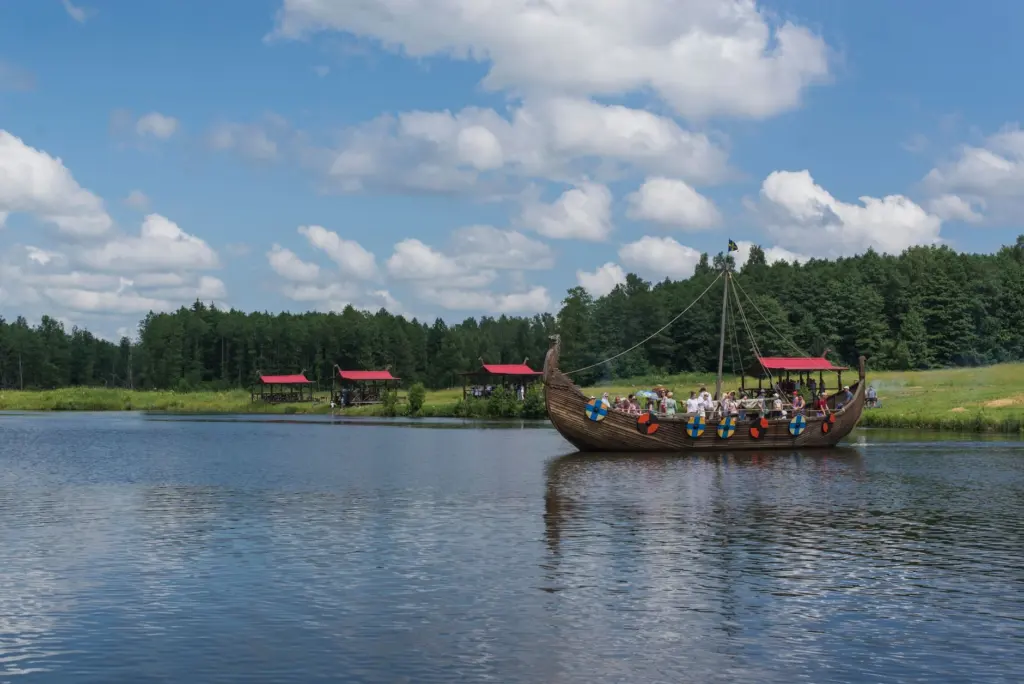
The museum’s research also went beyond the sea trial. Tank tests of Oseberg hull models covered conditions up to 20 knots and up to 15 degrees of heel, with a drift angle of 10 degrees. Those figures describe the test envelope used to study the hull form. They do not show that a real ship sailed at 20 knots, so do not quote them as a speed.
Two practical points follow. First, speed depended on more than the hull: the oars gave the ship power when sail alone was not the best option. Second, heel and shipped water set the real limit in rough conditions, which is why handling in wind matters as much as the top figure.
Where to see original Viking ships
The Oseberg ship is the one original ship that the verified material places on public display: it is exhibited at the Viking Ship Museum in Bygdøy, Oslo. It was built in AD 820, buried in a grave mound 14 years later and excavated in 1904. When excavated it was deformed and broken into about 2000 fragments. It was then re-assembled, and almost 95% of the ship has survived. That makes it a rare chance to see a ship that is mostly original timber rather than a replica with a few old fragments.
Use the three ships differently when planning a trip or a study session:
- Oseberg for the complete picture. Visit the Oslo museum if you want to see a hull whose shape, stepped planking and size (21.5 m by 5.0 m) are visible together.
- Gokstad for the rig. Its preserved mast and keelson are the evidence to compare with any reconstruction drawing. Confirm with the museum which parts are on display before you travel.
- Roskilde for reconstruction and process. The Roskilde Viking Ship Museum documents its boatyard building projects, including the Oseberg reconstruction, and is the place to see how modern builders test the evidence.
Opening hours, ticketing and which hulls are on show can change, so check each museum’s own website before you book.
Longships in the wider Norse picture
The ships survive in part because they were buried: Oseberg went into a grave mound. For Norse beliefs about death, the guide to Ragnarök: The End And Rebirth Of The Norse World — What Happened, Who Dies, And What Survives (2026 Guide) – Scanheritage explores from the mythological side. For the written evidence of the period, the guide to Elder Futhark Runes: A Practical Guide To Origins, Meanings, And Use In 2026 – Scanheritage covers runic writing.
Frequently asked questions
What were Viking sails made of?
Sails were densely woven wool or flax treated with horse mane fat, according to the World Tree Project’s account of Viking ship features.
How much rope did a larger longship need?
Thousands of meters of rope were required to rig a larger Viking ship, so the rigging was a major part of the construction effort.
Is the Oseberg ship on display original or a replica?
It is mostly original. It broke into about 2000 fragments when excavated in 1904, was re-assembled, and almost 95% of the ship has survived, according to the Roskilde Viking Ship Museum.
Did a reconstruction of Oseberg ever sail successfully?
The 1987 reconstruction Dronningen sank during its first sea trial in windy conditions, after shipping water over the sheer strake at roughly 9 knots.