

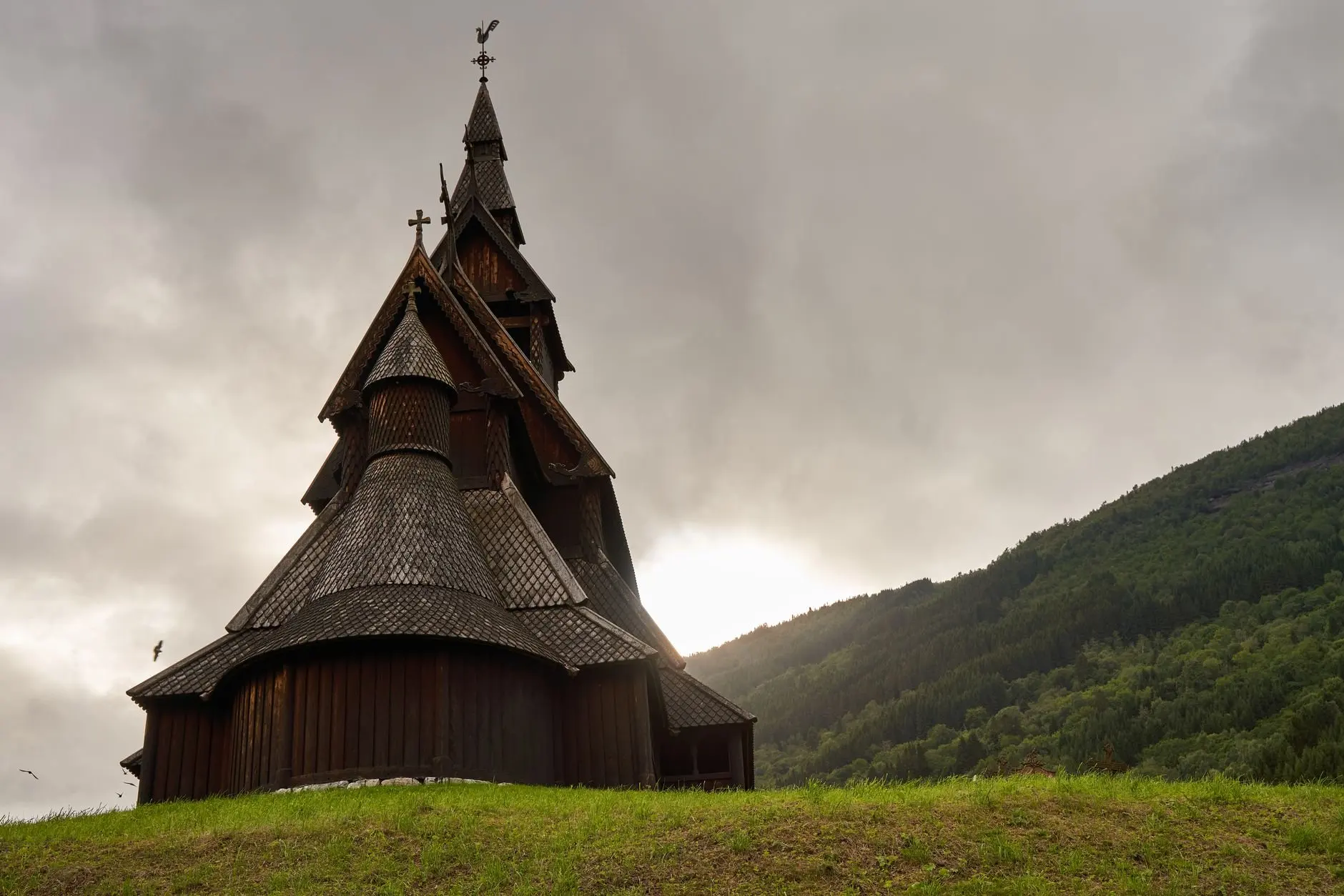
A traveller who expects either a ruin or a modern copy finds neither. The Hopperstad stave church in Vik was built around 1130 and restored in the 1880s, so it is medieval timber with a documented repair layer.
The sections below separate what is documented from what visitors commonly assume, then cover the practical side of a visit. For the wider logic of choosing, timing and booking a trip like this, see our guide on how to plan a cultural heritage trip.
Common misunderstandings about Hopperstad
Most confusion comes from the church’s two lives. It had a medieval origin, then an organised restoration in the 1880s led by the architect Peter Blix. Neither fact cancels the other. A sensible visitor holds both in mind: the church is old, and some of what you see reflects a restorer’s judgement about how a stave church of this kind should look.
| Common assumption | What the evidence supports | Planning use |
|---|---|---|
| The restoration means the church is essentially a 1880s building | The church dates from around 1130. Peter Blix carried out a major restoration in the 1880s, working from similar stave churches such as Borgund and from remains of the original church. | Treat Hopperstad as a medieval church with a significant restoration layer, and ask your guide which parts are original. |
| Its medieval appearance is fully documented | Little is known about how the church looked in the Middle Ages. | Expect an informed reconstruction rather than a certain record, and compare it with Borgund if you visit both. |
| Dragon heads mean the church was pagan, or that the art is purely Christian | The decoration of stave churches is a mix of Christian and Viking symbolism. | Read the carvings as a blend of traditions and do not force them into one category. |
Figures and descriptions above come from the stavechurch.com entry for Hopperstad and Fjord Norway’s overview of stave churches.
When Hopperstad was built and how it was restored
Hopperstad stave church dates from around 1130, and its restoration took place in the 1880s. Those two dates frame everything else about the building, and each needs a little context.
Origins around 1130
The stavechurch.com entry places the church in Vik in Sogn at about 1130. Fjord Norway likewise traces its origins back to around that year. Some descriptions give the mid-1100s instead, so 1130 works best as an approximate marker, not a foundation-stone date. For planning, “12th century” is the safe way to describe it.
That date puts Hopperstad early in the story of Norwegian stave churches. Fjord Norway notes that stave churches were built in the 12th and 13th centuries, and that most of those still standing date from between 1150 and 1350. Hopperstad therefore sits at, or slightly ahead of, the start of the period that produced the surviving group.
From parish building to protected monument
The sequence of events explains why the church survives as a visitable monument. A new church was built in 1877, and the stave church was then sold to Fortidsminneforeningen. The restoration followed in the 1880s under the architect Peter Blix. A second description from AroundUs names him as Peter Andreas Blix and also dates his major restoration work to the 1880s, which confirms the decade and the architect, though not the finer detail of what he altered.
Fortidsminneforeningen is still listed as the operator of the site. That continuity matters for visitors, because the organisation that rescued the building is the one that runs access to it today.
What the restoration can and cannot tell you
The restoration was based on similar stave churches, such as Borgund, and on remains of the original church. The same source adds that little is known about the church’s medieval appearance. Together, those statements describe a careful reconstruction in which comparison with sister buildings filled gaps that physical remains could not.
The practical consequence is simple. If you want certainty about which timbers are medieval, a guided visit is the better route than a photograph. If you only want the atmosphere of a medieval stave church, the restoration does not diminish it.
Design and carvings
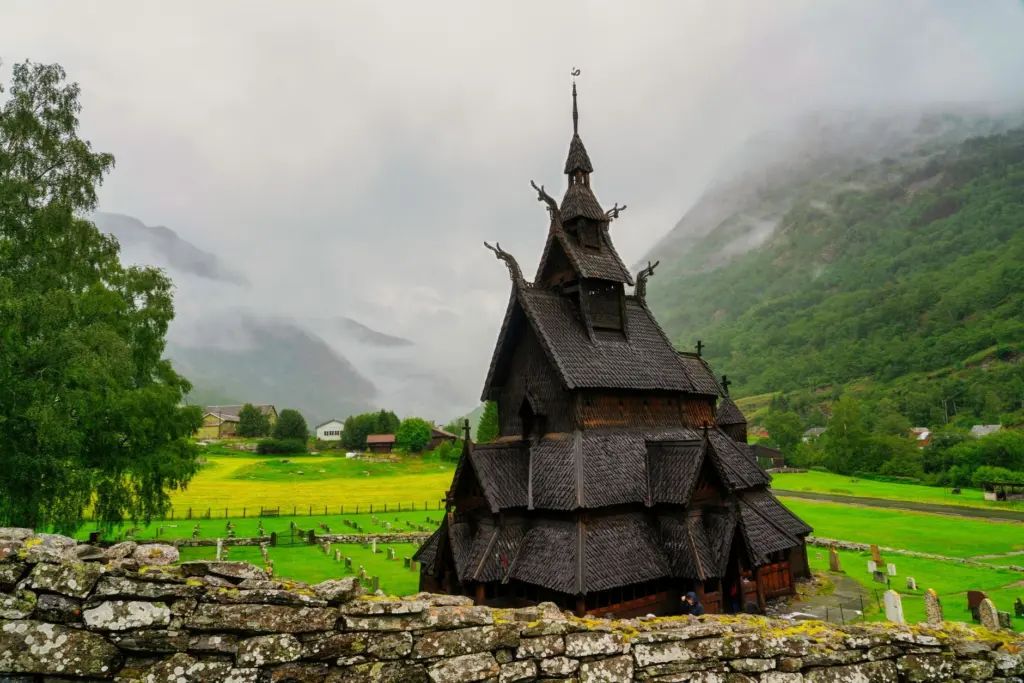
Hopperstad stave church is notable for a handful of specific features: a medieval west portal, a canopy of around 1300, a multi-layer roof with dragon-head details, and a preserved narrow choir opening. The details below come from the stavechurch.com description.
The portal and the canopy
The west-facing main portal is described as a fine example of medieval woodcarving, with raging dragons and interlaced vines. This is the carving most visitors remember, because it greets you before you step inside.
Inside, the canopy dates from around 1300 and is described as unique of its kind. Its painting shows the birth and early years of Jesus. The canopy therefore belongs to a later stage than the church’s origin around 1130, which is a reminder that a medieval church accumulates features rather than appearing complete.
The roof and the choir
The roof is multi-layered and carries dragon-head details. The church is also described as the only one in which the original narrow choir opening is preserved. That is the claim to ask about on a tour, since the opening is a structural detail rather than a decorative one, and it is easy to walk past without noticing it.
Three ways to read the art
- Mixed symbolism, not a contradiction. Fjord Norway describes stave church decoration as a mix of Christian and Viking symbolism. Dragons and vines sit comfortably beside Christian imagery, so look for both on the same surface.
- Carvings and paintings belong to different moments. The portal carving is medieval, and the canopy is dated to around 1300. Do not assume that everything you see was made at the same time as the church’s origin.
- Restoration is part of the object. Because the 1880s work drew on Borgund and surviving remains, some visual coherence may come from the restorers. Treat the overall silhouette as a considered reading of the medieval church, not a photograph of it.
Visiting Hopperstad
Hopperstad stave church stands at Hopperstadvegen 61, 6893 Vik i Sogn, with GPS coordinates 61.07748, 6.56902, according to AroundUs. The stavechurch.com entry places it in Vik in Vestland, and many older guides file the area under Sogn og Fjordane. Use the address or coordinates for navigation rather than the county name.
Tours, hours and tickets
AroundUs reports that the church is open for guided tours year-round. That makes a tour the normal way to see the interior, so build your visit around tour availability instead of expecting to walk in whenever you arrive. Specific opening hours and ticket prices are best confirmed directly with the site before you travel.
The stavechurch.com entry gives a visitor contact, Edel Berg, on telephone 401 55 971. A call is the most reliable way to check tour times, prices and any group arrangements, and it is the better choice if your trip depends on a particular day.
Fitting it into a wider trip
Hopperstad suits travellers who like to see how a building’s history is layered, and it rewards a visit with a guide more than a quick stop. If you are comparing it with other stave churches, remember that Fjord Norway counts 28 as surviving, many of them in Fjord Norway, so a route can combine several. Borgund is the comparison most relevant here, since it informed the 1880s restoration.
For the order of booking, transport and timing, how to plan a heritage trip sets out a step-by-step checklist. For the cultural background to the traditions around such places, read Norwegian Culture And Traditions: How Norway’s Heritage Shapes Daily Life In 2026 – Scanheritage.
Frequently asked questions
| Question | Answer |
|---|---|
| Is the Hopperstad church in Moorhead, Minnesota the original? | No. It is a replica, built between 1996 and 2001, according to the Hopperstad Stave Church Replica site. The original is in Vik, Norway. |
| How many stave churches survive in Norway? | Fjord Norway says 28 remain today, many in Fjord Norway, and that most were built between 1150 and 1350. |
| Why are there dragons on a Christian church? | The Hopperstad Stave Church Replica site describes dragons in stave churches as pagan guards against evil that sit beside religious art and crucifixes. Fjord Norway also describes the decoration as a mix of Christian and Viking symbolism. |
| Who runs the church today? | AroundUs lists Fortidsminneforeningen as the operator. The organisation acquired the church after the new church was built in 1877. |