


Seen a hammer pendant in a museum and another on a film screen? In mjolnir norse mythology, Mjolnir is Thor’s hammer, a weapon against giants that also hallows; Viking Age amulets are generally read as protective objects.
The Eddas are written accounts and the amulets are physical finds, and the two should be read differently. A short grounding in what are primary sources in history helps when deciding how far a story can explain an object, and how far an object can confirm a story.
What Mjolnir is in the written sources
Mjolnir is Thor’s hammer. Medieval sources describe it both as a weapon against giants and as an instrument of hallowing and restoration. Thor himself is the son of Odin the Allfather and the personified earth, so the hammer belongs to a god with a place in the highest family of the Norse pantheon.
The Edda says Mjolnir will never miss and will never fly so far that it fails to return to Thor’s hand. According to Skáldskaparmál, it returns to Thor and can be carried inside his shirt. Taken together, these details describe an object that is always available to its owner, does not get lost and can be hidden from view. That is closer to a personal attribute of the god than to a tool he might lend out.
Common misunderstandings at a glance
Most confusion about Mjolnir comes from reading one kind of evidence as if it were another. The table sets the usual assumptions beside what the supplied evidence supports.
| Common assumption | What the evidence supports | Planning use |
|---|---|---|
| Mjolnir is only a weapon | Medieval sources describe it as a weapon against giants and as an instrument of hallowing and restoration | Look for blessing scenes, not only fight scenes, when reading the poems |
| The hammer was flawless | In Skáldskaparmál the handle is too short because Loki interrupts the forging | Treat the flaw as part of the origin story |
| Hammer amulets were only jewellery | Roughly 1,000 Viking Age hammer amulets are known and are generally interpreted as protective objects | Read pendants as protection first, adornment second |
| The Eddas record Viking Age belief first-hand | Snorri Sturluson’s Edda was written in the thirteenth century, after Iceland’s conversion to Christianity | Use it as a later retelling, not an eyewitness record |
| The film hammer is the mythic hammer | Modern screen versions show it as spectacle, with Chris Hemsworth wielding it across a CGI battlefield | Check a screen image against the texts before repeating it as myth |
These points are drawn from a survey of the medieval sources on Mjolnir, which also underpins the detailed sections below.
Weapon and hallowing object
The first misunderstanding is that Mjolnir only destroys. The texts give it at least three roles, and the quieter ones are easy to miss if your picture of the hammer comes from adaptations.
- Weapon against giants. This is the role most readers expect, and the medieval sources do describe the hammer as a weapon against giants.
- Restorer of life. In Gylfaginning, Thor lays Mjolnir over the skins and bones of his slaughtered goats, and the animals rise again. Here the hammer works as an instrument of restoration rather than violence.
- Consecrator of marriage. In stanza 30 of the Poetic Edda poem Þrymskviða (Thrymskvida), Mjolnir is laid in the bride’s lap to hallow the marriage.
The wedding scene matters because it shows the hammer used in a social ritual and not only in combat. If you are reading Þrymskviða for the first time, watch for that moment, since it is the clearest textual bridge between the god’s weapon and the protective, blessing-oriented meaning later given to small hammer pendants. The goat episode and the wedding scene both involve laying the hammer on something, which suggests that hallowing, in these accounts, is done by placing the object rather than throwing it.
How the myths describe the making of Mjolnir
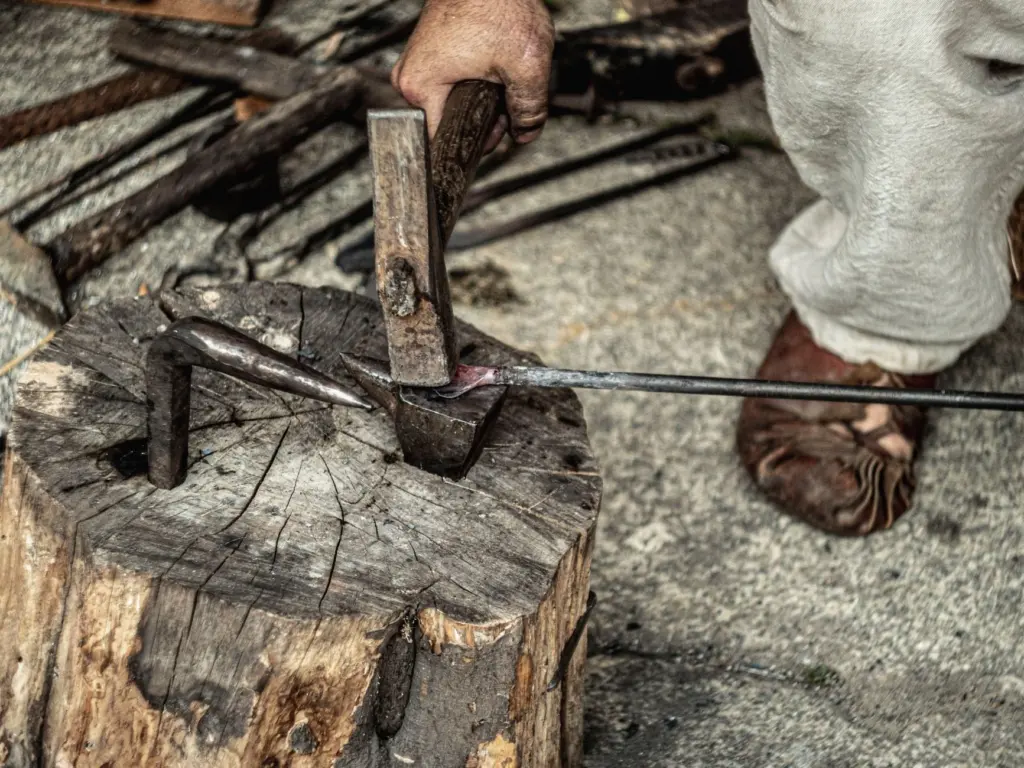
In the myths, Mjolnir is a forged object with a flaw. In Skáldskaparmál the hammer’s handle is too short because Loki interrupts its forging. Transformed into a fly, he bites Brokkr’s eyelid while Brokkr works the bellows, and the work is disturbed at a critical moment.
The practical lesson for readers is that the story does not present the hammer as a perfect divine gift. Its imperfection is written into its origin, and the short handle is explained as the result of Loki’s interference rather than ignored. Anyone drawing or describing Mjolnir from the texts should keep that detail, because it is one of the few physical features the supplied sources actually state.
Hammer amulets and their findspots
The best archaeological counterpart to the myth is the hammer amulet. Archaeologists know roughly 1,000 Viking Age hammer amulets, generally interpreted as protective objects, according to the same survey of sources. So when you ask what hammer amulets meant, the supported answer is protection, not decoration and not a precise statement of belief.
The Ysby amulet from Sweden shows what one of these objects looks like. According to reporting on the find, it is:
- Small. It measures 3 cm (1.18 inches).
- Cast in lead. There is a hole through the shaft, which implies it was worn as a pendant.
- Dated to about the 10th century. It is the first Thor’s hammer found in Sweden’s Halland province.
Archaeologists believe the hammer was worn around the neck as a symbol of protection. A pendant of this size is a personal object, carried close to the body, which fits the idea of protection better than display. The findspot is also worth noting: a first find in Halland shows the symbol turning up in a new region, but one pendant cannot show how common the hammer was there.
Reading the Eddas and the objects together
The Prose Edda and the amulets come from different worlds. Snorri Sturluson’s Edda was written in the thirteenth century, after Iceland’s conversion to Christianity, while the Ysby amulet dates to around the 10th century according to the find report. The written account therefore comes from a Christian-era author describing older beliefs, and the pendant belongs to the earlier period itself.
That gap suggests a sensible way to read them. Use the texts to understand what Thor’s hammer does in the stories: it hits giants, returns, restores and hallows. Use the objects to see that people wore a hammer-shaped symbol and that archaeologists read it as protective. The link between the two is thematic. The hammer protects in the myths, and the amulet is generally interpreted as protective, but no supplied source shows a specific amulet illustrating a specific episode, so avoid claiming one does.
If you want to follow another Eddic story beyond Thor’s, Baldur: The Radiant God Whose Death Shaped Norse Myth (A Clear Guide) – Scanheritage covers a different god. For a different Norse symbol system, Elder Futhark Rune Stones: A Practical Guide To Meaning, Use, And Care (2026) – Scanheritage is the natural next read.
Mjolnir today
Today, Mjolnir is most visible through popular culture, above all in Marvel’s screen portrayal, where Chris Hemsworth wields it across a CGI battlefield. Those versions put the emphasis on spectacle and strength.
The medieval record is broader. It also shows the hammer returning to its owner, restoring slaughtered goats and hallowing a marriage, and archaeology adds the small protective pendant. If you meet Mjolnir in a film, game or pendant shop, a useful test is to ask which of these roles is on display. A version that shows only the weapon is drawing on one part of the evidence, not the whole of it.
Frequently asked questions
| Question | Answer |
|---|---|
| Is the meaning of the name Mjolnir settled? | No. A link with words meaning “to grind” or “crush” is considered probable but not certain, and another proposal connects the name with cloud or darkness. |
| Who are Thor’s parents? | Thor is the son of Odin the Allfather and the personified earth. |
| Do hammer amulets prove the Mjolnir myths? | Not by themselves. They show that a hammer symbol was worn and is generally interpreted as protective, but they do not reproduce any particular story from the Eddas. |