

| Detail | What is supported | Planning use |
|---|---|---|
| Location | Heddalsvegen 412, 3676 Notodden, in Telemark; roughly 1 hour 45 minutes to 2 hours by road from Oslo, depending on traffic | Allow for the drive each way when starting from Oslo, and leave margin for traffic. |
| Construction | Around 1250 | Treat it as a medieval building that has been repaired many times, not an untouched survivor. |
| Size | 25 m long and 17 m wide | The scale is in the roofline, so spend time outside as well as inside. |
| Opening | Hours vary by season; usually open daily in summer | Aim for summer and confirm hours before you set out. |
| Entry and tours | A modest entrance fee may apply for the interior; tours are typically in English and Norwegian in summer | Carry a means of payment and time your arrival around a tour. |
Details come from Visit Nordic and the Norway Explained travel guide.
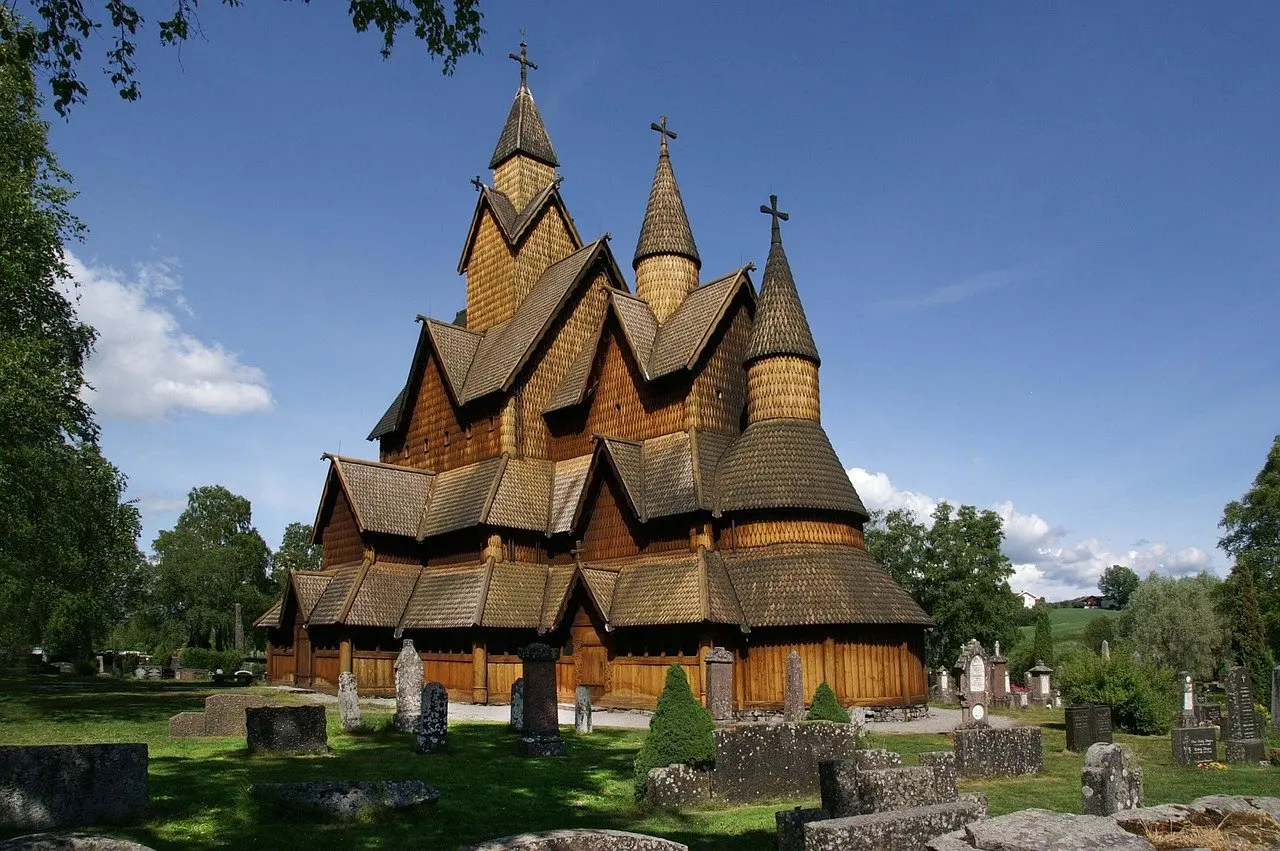
Heddal stave church, near Notodden in Telemark, dates from around 1250 and is the largest of Norway’s 28 preserved stave churches. Visit in summer, when it is usually open daily, because winter access is limited.
If this stop belongs to a longer itinerary, read how to plan a cultural heritage trip for the wider checklist, then use the sections below for the church’s own conditions.
Planning around seasons, fees and tours
Summer is the season to build a visit around. According to Norway Explained, the church is usually open daily in that period, guided tours run regularly, and the small café and shop often operate. Outside summer the picture narrows: Viking Sites Norway lists the visiting window as spring to autumn, with limited winter access.
- Choose summer if you want the interior and a tour. Guided tours are typically offered in English and Norwegian in summer, so visitors who speak neither language should expect to rely on signage or their own preparation outside that season.
- Budget for a possible entrance fee. A modest fee may apply to see the interior during visitor hours. No fixed price is quoted, so check the amount at the entrance rather than assuming the exterior and interior cost the same.
- Check hours before the drive. From Oslo the trip takes roughly 1 hour 45 minutes to 2 hours depending on traffic, which is long enough that a closed door is an expensive surprise. Shoulder-season visitors gain most from confirming first.
- Build the day around the church, not just a photo stop. The exterior is the part you can enjoy at any time, while the interior depends on visitor hours.
Those practical limits make more sense once you see what the building is, which starts with its size.
Size and design: what makes it the largest
Heddal stave church is, in Visit Nordic’s description, the largest of Norway’s 28 preserved stave churches. It is 25 m long and 17 m wide, and it has three towers, 64 roof surfaces and an external gallery. A Vintage News account puts its height at around 26 m. The layered roofline is what turns a modest footprint into a tall silhouette, so walk the full circuit outside before going in.
The name explains the structure. Stave churches are named after their load-bearing staves, the timber posts that form the skeleton of the building. The same Vintage News account describes these posts as made from ore-pine. At Heddal, a triple-nave floor plan is supported by massive pine staves set directly into the ground. That post-and-frame logic is why the building reads as a structure of posts and tiers rather than solid walls.
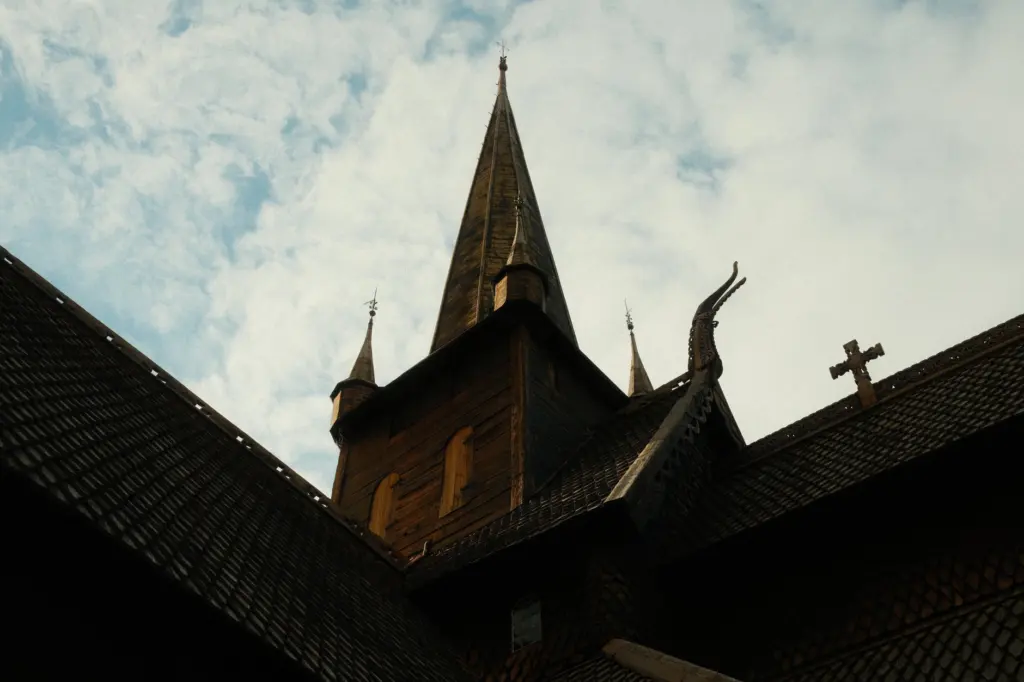
The roof detail is only part of the decoration, which also includes carved doorways and surviving paint.
Carvings and wall paintings
Carved decoration is concentrated on the doorways and capitals. Viking Sites Norway notes that these carvings preserve traces of Norse artistic traditions, with motifs such as dragons, vines and interlaced beasts. The same source records that remnants of 14th- and 15th-century wall paintings survive inside. For visitors, that makes the entrance and the pillar tops the best places to slow down, because they hold the densest ornament.
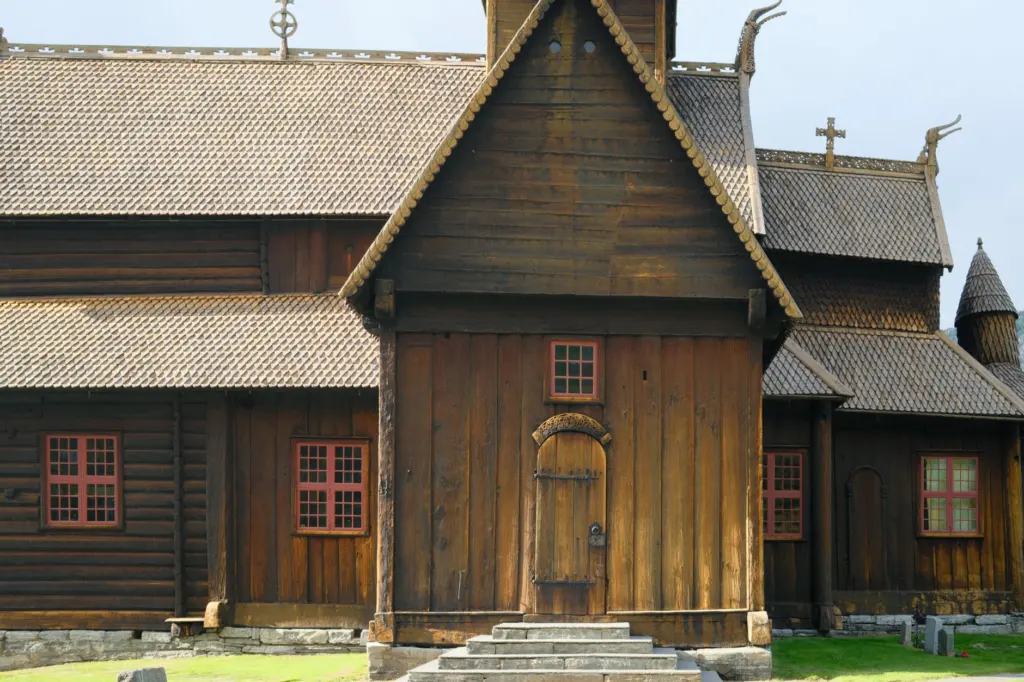
The paint and carving survived because the building was repaired rather than replaced, and the repair history is worth knowing before you go.
Restoration history and what it left behind
The church needed rescuing within its own history. The first restoration took place between 1849 and 1851 in an effort to save the crumbling building from ruin. About a hundred years later, a second effort was necessary to undo the damage done by that clumsy first restoration. In the same account, the last repair is largely responsible for today’s interior, which was also influenced by the Reformation of 1536–1537.
Broader summaries agree on the shape of the story. Restoration campaigns in the 19th and 20th centuries stabilized the structure and recovered medieval details. The practical lesson is that you are looking at a layered building. Some of what looks original reflects later choices, so a guided tour is useful for separating medieval fabric from repair work.
- For a quick visit: concentrate on the roofline, the doorway carvings and the pillars inside.
- For a deeper visit: join a tour in summer and ask which parts date from which repair campaign.
- For comparison: treat Heddal as a reference point for other preserved stave churches rather than as an unaltered medieval time capsule.
Construction date and local legend
The dating differs slightly by source, which matters if you want to quote it. Visit Nordic gives around 1250. Viking Sites Norway places construction in the early 13th century, around 1200–1250. Vintage News says the beginning of the 13th century, and a venue listing says the middle of the 13th century.
The safest answer to when Heddal stave church was built is therefore the first half of the 13th century, roughly 1200–1250, with around 1250 as the figure most often quoted as a single date.
Local legend adds a different story. According to the Vintage News retelling, the church was built in only three days. Treat that as folklore, not a construction record, but it is a good conversation point on a tour.
Where Heddal fits among Norway’s stave churches
Heddal stands out for scale and for being active. Besides being the largest of Norway’s preserved stave churches, it is still functioning, and in summer it is used for weddings, confirmations and services. It sits near Notodden in Telemark, which makes it a natural anchor for a regional heritage day rather than a stop that needs a long detour from a bigger route.
If you are building a wider Norwegian itinerary, the background in Norwegian Culture And Traditions: How Norway’s Heritage Shapes Daily Life In 2026 – Scanheritage helps explain why a working medieval church matters locally. For a very different kind of Nordic day outing, compare it with Iceland Golden Circle Itinerary: The Perfect 1‑Day Route With Timing, Tips & Maps (2026) – Scanheritage.
Frequently asked questions
Is the church accessible for visitors with limited mobility?
Partly. Norway Explained says the churchyard paths are mostly level, but entry involves a small threshold and the interior has uneven floors and low light.
Can I take photographs?
Outdoor photography is encouraged. Inside, flash may be banned in some periods to protect older paint layers and wooden surfaces, so keep it off unless staff say otherwise.
Is there a café or toilet on site?
Yes. Visit Nordic lists a cafeteria, exhibitions and toilets in the neighbouring Parish Barn.