

Expect a dark, timber-framed room rather than a bright decorated nave: the borgund stave church interior has no electric lighting, so your eyes need time to adjust and a staff member uses a flashlight for guests.
Most surprises at Borgund come from assumptions about light, age, ownership and tickets, and each is sorted out below. If the church is one stop in a longer route, our guide on how to plan a cultural heritage trip helps you decide how much time to give it.
Light and atmosphere: expect dark, not bright
The first misunderstanding is about brightness. One visitor account says that inside, the church is very dark. Another notes that there is no electricity inside, which is why a staff member uses a flashlight for guests. In practice, do not judge the room in your first minute. Let your eyes adjust, then look up and along the walls, because that is where the detail is.
The same visitor account describes St. Andrew’s crosses running along the very tall walls. They are the most legible decoration in the dim light, and they show how the builders used the timber frame itself as the visual structure. The altarpiece at the front dates to the 17th century, so it is a later addition to a medieval building rather than part of the earliest fabric. Seeing an object from a later period beside much older timber is part of how the interior reads.
The table below separates three common assumptions from what the evidence supports.
| Common assumption | What is supported | Planning use |
|---|---|---|
| Interior lighting will show everything clearly | No electricity inside; the interior is very dark and a staff member uses a flashlight for guests | Allow time for your eyes to adjust and stay with the guiding light rather than expecting to browse freely |
| The building is mostly a reconstruction | The church is about 85% original | Treat the timber around you as largely the work of the original builders |
| Every fitting dates from the Middle Ages | The altarpiece is 17th century | Expect later additions to sit among much older timber |
Figures are drawn from a visitor’s detailed account and a second travel account of the church.
Structure and ornament: what holds the room up
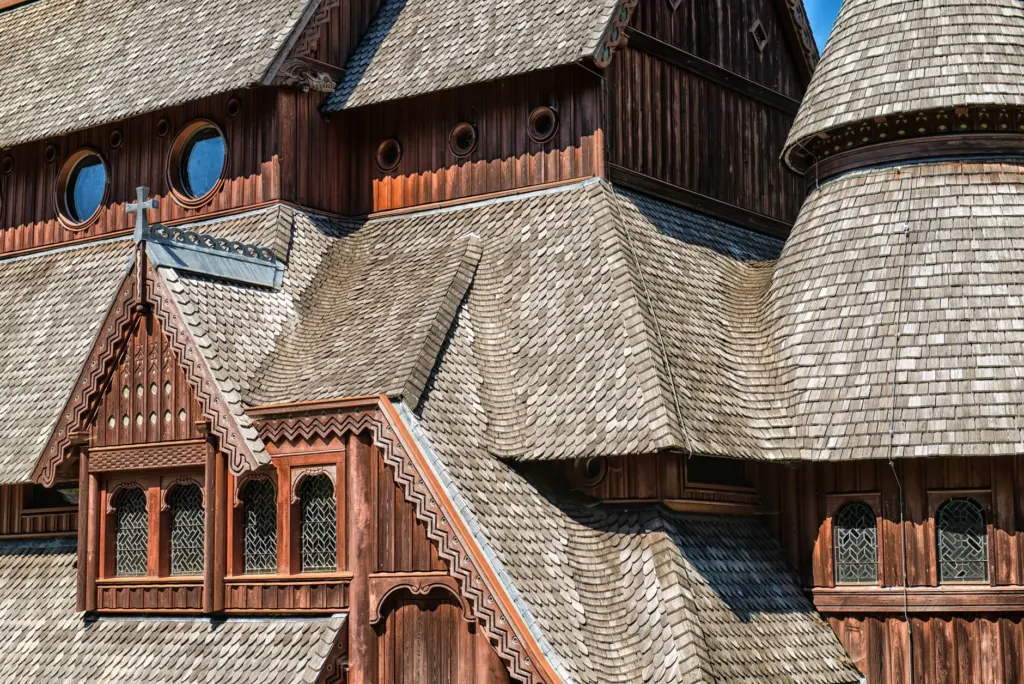
Borgund is a stave church, and the name describes its method. Stave churches were built with load-bearing posts, called staves, and vertical wall planks. The posts stand on stone foundations, which keeps the timber structure on a stone base. That is why the inside feels like a forest of timber rather than a hall with decorated walls: the structure and the interior are the same thing.
Another assumption is that a medieval wooden church must be held together with iron. The same account says these churches were not put together with metal objects like nails, and wooden dowels were used instead. For a visitor this explains why the interior shows no metal fixings as part of its design, and it has consequences for how the building is looked after, covered further below.
- Load-bearing staves: the vertical posts carry the building, so the timbers you see are structural, not decorative panelling.
- Vertical wall planks: the walls are formed of planks set upright between the posts.
- Dowels, not nails: wooden pegs join the timber, so look for the wood-on-wood joinery rather than metal fittings.
- Medieval style in wood: a catalogue entry for the church lists the style as medieval and the primary material as wood, with a religious function.
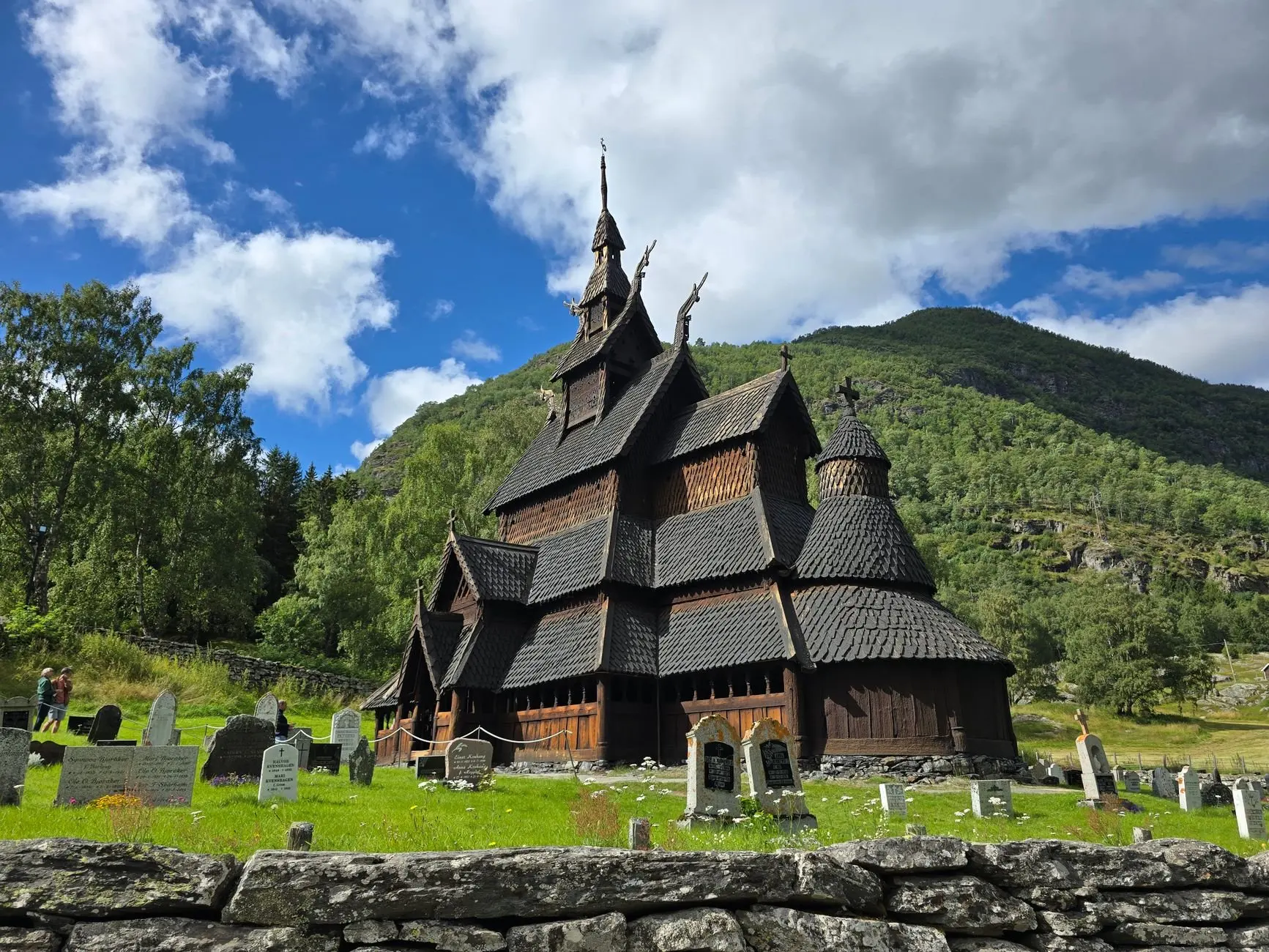
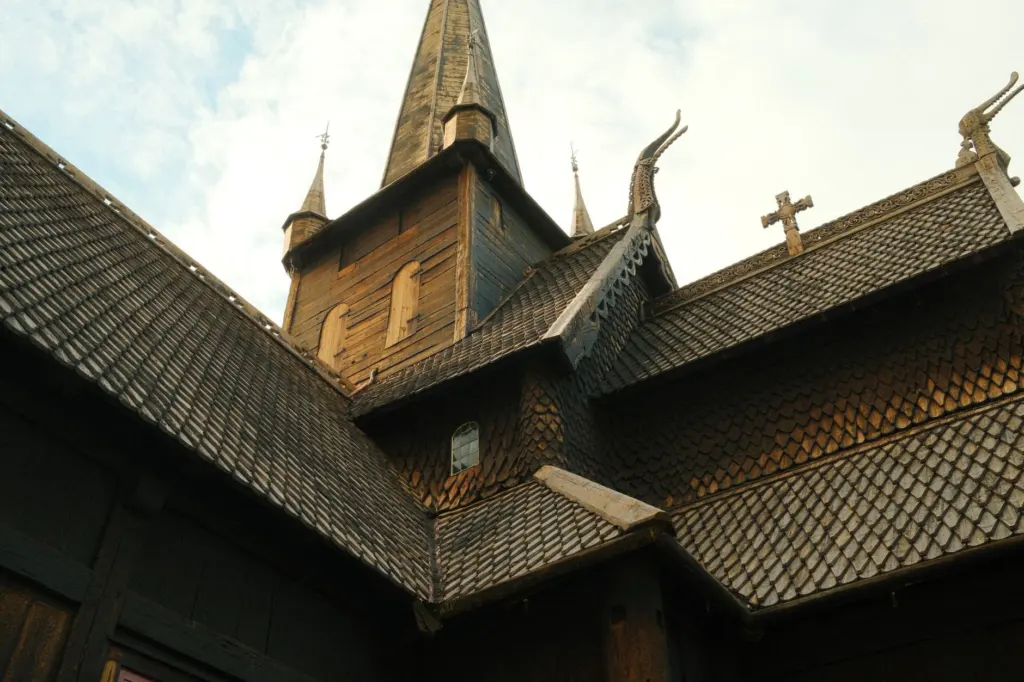
The most famous ornament is on the outside rather than the inside. Four dragon heads sit at the top of the steeple on the gable ridges. If you want the layered roofline in a photograph, take it before you go in, since the interior will not give you the same view.
Age and originality: old timber, not a copy
Borgund stands at Lærdal, which one source places in Sogn og Fjordane county, Norway. Its timber is old: the carved doorways and timber framework have survived more than 800 years, which is why Borgund is described as one of Norway’s best-preserved stave churches. That answers the question of how old it is in a way a visitor can use. The fabric you are standing in dates from the medieval period, and the building is not a later imitation of one.
Do not read the figure as an exact construction date, however. The evidence supports a minimum span of survival for the carved doorways and framework, not a precise year for each part. The same applies to the idea that the church is entirely untouched. A visitor account puts the building at about 85% original, which means a meaningful share is not original. That is the honest framing for a medieval timber building exposed to weather over centuries: most of what you see is old, and some of it has been replaced or added.
For a visitor, this is a reason to look closely rather than assume. The timber posts, the portals and the framework carry the age, while features such as the 17th-century altarpiece show that the church has also kept changing.
Ownership and conservation: a museum, not a parish church
Another common assumption is that a church this old must still hold regular services. It is now a museum run by the Society for the Preservation of Ancient Norwegian Monuments, known in Norwegian as Fortidsminneforeningen. It is no longer used for regular worship. That changes how you should behave inside: you are visiting a preserved monument, and the rules of access serve the building first.
Wood conservation here starts from the way the church was made. Because the structure relies on staves, planks and wooden dowels rather than metal, repair work on this kind of building has to deal with timber as both structure and surface. The practical result for visitors is visible in the access arrangements: thresholds, uneven surfaces and protected-building constraints are part of the site, and they are not likely to be smoothed away for convenience.
The setting also deserves respect. Visitors should treat the surroundings as part of a living place, not only a monument, and the next section covers how to arrange the visit itself.
Planning a visit: tickets, seasons and access
Start at the visitor centre. You must purchase a ticket there before walking to the stave church, so do not head straight for the building. The same account gives the distance from Flåm to the visitor centre as about 60 km, which suits a day trip by road from that fjord village.
- Opening hours and prices: most stave churches keep seasonal hours and close during the winter. Check current opening times and ticket prices with the site operator before you travel, since a winter trip may find the church closed.
- Light and photography: the dim interior means you should plan to look first and photograph second. The guiding flashlight is for the visitors, so follow staff direction.
- Access: the thresholds and uneven surfaces mean the building suits visitors who can manage steps and rough ground. If mobility is a concern, ask the operator what can be done on the day.
- Nearby walking: Vindhellavegen is a historic mountain road with dramatic stone walls and hairpin bends, a natural companion if you have extra time.
If Borgund is part of a longer Nordic trip, our Iceland Ring Road Road Trip: A Practical 7-Day Itinerary + Timing Tips (2026) – Scanheritage covers a different kind of landscape-led route. If your dates fall in winter, when stave churches tend to close, a city option such as Copenhagen In December: 12 Cozy, Festive Things To Do For English-Speaking Visitors – Scanheritage may fit better than a rural monument that may be shut.
Frequently asked questions
| Question | Answer |
|---|---|
| How long should I allow at Borgund? | One visitor allotted an hour for the church and the exhibition and found it enough. Add time if you want to adjust to the dim light or walk nearby. |
| Is Borgund on the UNESCO World Heritage List? | No. The Norwegian stave church on the list is Urnes. Borgund’s value lies in its well-preserved timber interior and framework. |
| How many stave churches survive in Norway? | One account says 28 remain, though another source gives 28 or 29, so treat the count as approximate. |
| Is the churchyard still in use? | Yes. The graveyard around the church is still active today, so keep voices low and respect the surroundings. |