

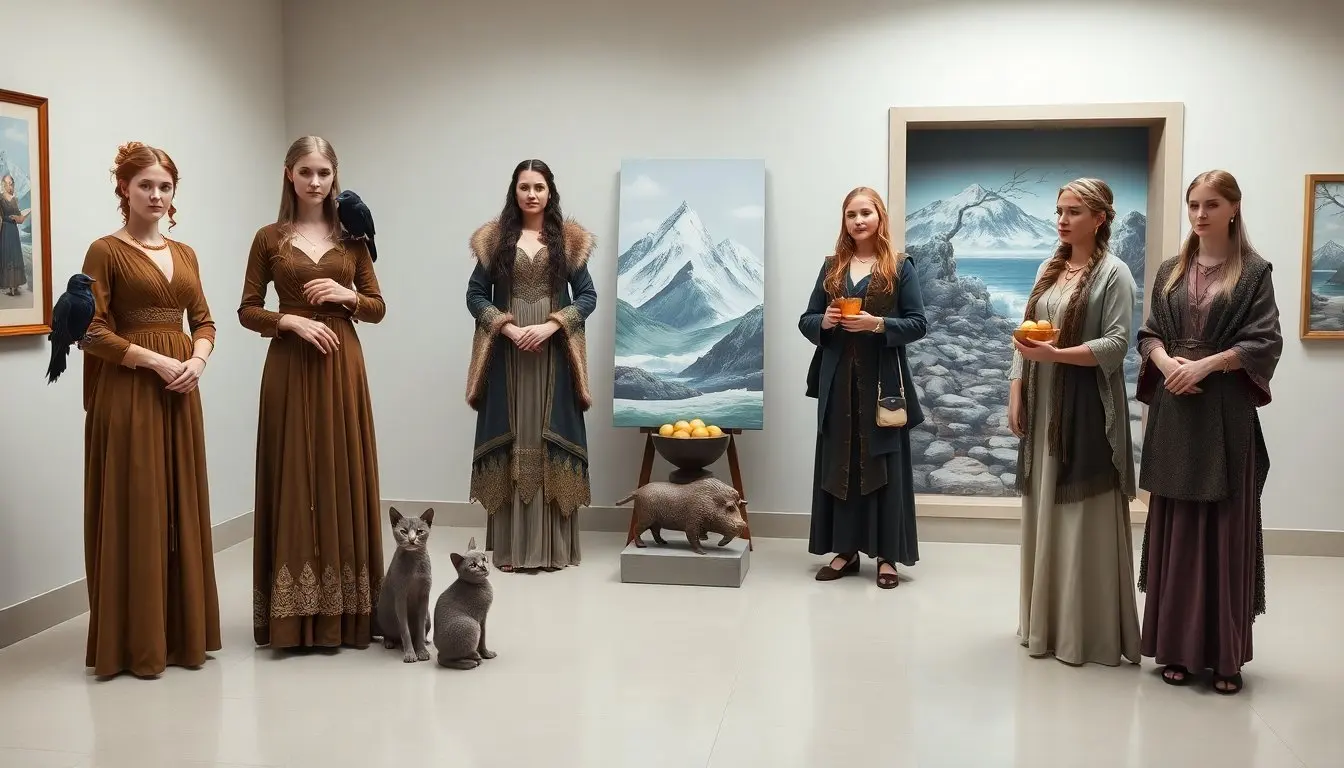
Norse mythology goddesses shape stories, law, and craft across Old Norse texts. This article lists key figures and explains their roles. It focuses on clear facts and short stories. Readers will learn who these women were and how people honored them.
Key Takeaways
- Norse mythology goddesses played vital roles as fate-weavers, healers, and patrons of craft, influencing both public rituals and daily life.
- Frigg, known as the sovereign mother and seer, was worshipped for childbirth, household law, and silent counsel, shaping family and social tradition.
- Freyja, a goddess of love, war, and seiðr magic, bridged social roles from warriors to poets and farmers, symbolizing female power and strategic force.
- Symbols like Freyja’s necklace and cats were central to worship, with offerings and altars used to invoke her protection and fertility blessings.
- Lesser-known goddesses Sága, Idunn, and Skadi each contributed to human survival through knowledge, youth restoration, and mastery of winter and hunting.
- Worship practices involved home shrines and public feasts, with goddesses guiding marriage, law, harvests, and safe journeys in everyday Norse life.
The Role Of Goddesses In Norse Cosmology
In Norse myth, goddesses share power with gods. They act as fate-weavers, healers, mothers, and patrons of skills. Society gave them public and private roles. Poets and law-speakers invoked them in verse and oath. Families kept small altars and offerings. The Prose and Poetic Eddas place women at crossroads of prophecy and household care. Scholars note that these women balanced warrior themes and domestic needs. Worship varied by region and by farmer or chieftain. The presence of goddesses guided rituals, marriage agreements, and craft traditions.
Beyond literary portrayals, archaeological evidence and place-name studies show how embedded norse mythology goddesses were in everyday life. Stone carvings, amulets, and grave goods reflect devotional practice: pendants with female figures or symbols, and graves furnished with tools or tokens that suggest a woman’s role in preparing food, healing, or ritual. Legal texts and commentary preserved in saga literature reveal that invoking a goddess could legitimize an oath or a settlement, and poets used female divine figures as metaphors for fate, wisdom, and the domestic order.
Themes associated with goddesses—fertility, craft, protection, and prophecy—often overlap, so the same figure could be petitioned for multiple needs. This blending of spheres made goddesses central to a community’s resilience: tending the household and storehouses, ensuring productive harvests, securing young lives, and offering counsel to leaders. Understanding norse mythology goddesses therefore requires attention to both mythic narrative and the practical contexts in which people appealed to them.
Frigg — The Sovereign Mother And Seer
Frigg appears as a queen and a seer. She receives reports from ravens and knows fate without speaking it. In myths, she acts to protect families and advise rulers. She holds a high seat in the sky and a weaving loom in some poems. People called on Frigg for childbirth and household law. She shared duties with other female figures when stories overlap. Later writers often link her with marriage customs and midwifery. Frigg’s image emphasizes care, counsel, and silent knowledge.
Textual sources portray Frigg as the matron of the Aesir household: hostess, counselor to Odin, and guardian of domestic order. Her association with weaving and spinning is not merely decorative; in many Indo-European traditions such crafts are tied to fate and social continuity, and Frigg’s loom becomes a symbol of how households and communities are bound together. In practice, supplicants sought her favor in matters of childbirth and the safety of kin, and women—particularly those overseeing births and upbringing—would invoke her name in prayers and charms.
Regional worship of Frigg likely took varied forms. High-status households could maintain shrines or dedicate feasts in her honor, while everyday reverence occurred in the activities of midwives, foster-mothers, and rulers’ wives, who acted as living agents of her authority. While the surviving narratives sometimes present Frigg as remote—holding knowledge she will not reveal—they nonetheless stress her central social function: maintaining bonds of kinship and law, and linking private home life with the political order.
Freyja — Love, War, And Seiðr
Freyja leads in love, desire, and battle magic called seiðr. She rides a chariot pulled by cats and keeps a famous necklace. She chooses half of the slain for her hall and teaches seiðr to other figures. Freyja acts both as a lover and a fierce patron of warriors. Farmers, sailors, and poets asked her for luck and victory. Her skills cross social lines: she helps births and war plans. Freyja’s stories show a mix of erotic power and strategic force.
Freyja is one of the most polyvalent figures among norse mythology goddesses: her associations range from erotic love and marriage to wealth, magic, and the battlefield. Her association with seiðr—a form of divination and enchantment—places her at the center of conversations about gender and sacred power, since seiðr practitioners could cross normative gender roles. As a receiver of the fallen and a patron of warriors, Freyja’s role complements the warrior ethos while also offering a distinctly feminine form of authority.
Material culture reflects Freyja’s popularity. Jewelry invoking her iconography—necklaces, pendants, and beads—appears in many contexts, from domestic hoards to burial assemblages, where such items can signal both devotion and social identity. Offerings to Freyja could be practical (meals, amber, livestock parts) or symbolic, and place names and runic inscriptions preserve traces of local cult practice. That breadth of evidence underscores why Freyja remains central when studying the range and complexity of norse mythology goddesses.
Symbols, Worship, And Legacy Of Freyja
Freyja uses symbols like the cat, the necklace, and the boar. People left amber, beads, and meat at her altars. Her name appears in place-names and in runic charms. Later folklore links her with fertility fairs and seasonal rites. Craftspeople used her image on pendants to ask for love or protection. Writers copied her attributes across centuries. Modern art and literature often borrow Freyja’s image as a symbol of female power and sensuality.
Symbolism mattered in how people encountered gods. Freyja’s cat-drawn chariot, for example, appears in visual motifs and may have been used in festival performance or storytelling to evoke her presence. The necklace associated with Freyja—often referenced in mythic narratives—also had practical analogues in ornamentation that signaled status, relational ties, and devotional intent. These objects functioned as both religious signifiers and everyday items that mediated human-divine relationships.
The long-term legacy of Freyja shows how norse mythology goddesses were reinterpreted and adapted: from medieval saga references to folk traditions and, in modern times, to literature and visual arts. Her attributes—desire, magic, and warrior patronage—continue to inspire reinterpretation, but the core pattern is consistent: a goddess whose sphere covers both intimate domestic concerns and the wider social obligations of protection, wealth, and ritual knowledge.
Sága, Idunn, And Skadi — Three Lesser‑Known But Important Figures
Sága, Idunn, and Skadi offer distinct gifts to humans. Sága hosts gods and shares knowledge by the sea. Idunn guards apples that restore youth. Skadi rules winter landscapes and teaches hunting. Saga songs credit Sága with counsel and drink. Idunn’s fruit keeps gods strong and long-lived. Skadi negotiates for a husband and shifts between wild and court life. Farmers and hunters honored these figures for survival, storage, and travel. Each woman fills a clear social need in myth.
Although they are less prominent in the surviving corpus than Frigg or Freyja, these goddesses illuminate how varied divine femininity could be. Sága’s role as a hostess and keeper of lore situates her at the intersection of memory, storytelling, and the transmission of knowledge. Idunn’s apples—often interpreted as a symbol of renewal and regenerative care—highlight the importance of food preservation, storage, and lifecycle management in a harsh northern environment. Skadi, with her mountains and skis, embodies the skills necessary for survival in winter: hunting, mobility, and legal negotiation (her marriage bargain in the sources underscores how women could assert agency through contractual means).
Locally, these figures could be focal points for particular activities: coastal communities might make offerings to Sága for safe passage and news, orchard-keepers and those who tended storage might invoke Idunn when preserving seed and food, and mountain communities or hunting parties would look to Skadi for success and protection. Their presence across different environmental zones shows how norse mythology goddesses addressed concrete ecological and social needs.
How Goddesses Were Worshipped And Their Influence On Daily Life
People worshipped goddesses at home and on communal hills. They set up small shrines, left food, and recited brief prayers. Women led many rituals, and men joined public feasts. Farmers asked for good crops and safe flocks. Sailors asked for calm seas and quick winds. Mothers asked for healthy births. Rulers sought counsel before war. Law-keepers cited divine will in disputes. The presence of a goddess in a household name or a field name shaped behavior and kept memory alive.
Worship practices ranged from private acts—wearing amulets, offering household foods, or invoking a goddess’s name in charms—to larger communal activities such as seasonal feasts, ritual sacrifices, and oath-taking ceremonies where a goddess’s favor was solicited on behalf of a kin-group or community. Women often played central roles in these rites as priestesses, midwives, or keepers of ritual knowledge, though men also participated in public ceremonies that affirmed social bonds and political authority.
The influence of norse mythology goddesses extended into legal practices and social norms. References to divine witnesses in disputes, the naming of places after goddesses, and the use of female deities as metaphors in skaldic poetry all contributed to a cultural environment where female divine figures shaped expectations about marriage, inheritance, seasonal labor, and hospitality. In short, these goddesses were not only subjects of mythic narrative but active components of a lived religious landscape that structured everyday decisions and long-term community memory.