

A reader meets Fenrir, Jörmungandr and Hel in one story and assumes they are all the same kind of villain. They are not: norse mythology monsters are best sorted by the job each one does in the myths.
That sorting also helps when retellings disagree. Before comparing versions, it is worth knowing what are primary sources in history, because most popular summaries, including the ones drawn on here, are modern retellings of much older belief.
The main Norse monsters at a glance
The beings people usually call monsters fall into a few roles: a wolf who threatens the gods, a serpent who surrounds the world, a ruler of the dead, a dragon at the base of the world tree, and landscape dwellers such as trolls. Calling them all “evil” hides the differences, so the table sets the roles side by side.
| Being | Kind | Setting | What the stories use it for | Common misreading |
|---|---|---|---|---|
| Fenrir | Monstrous wolf, child of Loki and Angrboða | Bound by the gods | A symbol of chaos and destruction; involved in Odin’s death at Ragnarök | That he was born a finished monster rather than one who grows larger and stronger over time |
| Jörmungandr | Serpent, child of Loki and Angrboða | Beneath the oceans, encircling the world | A world-ringing threat destined to meet Thor | That Thor simply wins; the two slay one another |
| Hel | Ruler of the underworld Helheim | The realm of the dead | Governs the fate of those who die from illness or old age | That she is evil; she is typically portrayed as neutral |
| Níðhöggr | Dragon | The roots of Yggdrasil | Guards the roots and constantly gnaws at the base of the tree | That it is a roaming beast rather than a fixture of the world’s structure |
| Trolls | Ancient beings | Remote landscapes | Cautionary or adversarial figures | That they are cartoon ogres rather than creatures tied to wild places |
The descriptions combine the creature overview at Routes North with the account of Norse creatures at Northlord.
Each entry rewards a closer look, because the misreadings in the last column are where most confusion starts. Fenrir comes first, since his story shows most clearly how a threat is made.
Fenrir: a threat that grows
Origins and growth
A frequent assumption is that Fenrir was a fully formed monster from the start. The tradition is more specific. According to Northlord, Fenrir was one of Loki’s three children with Angrboða, coming from giants. Routes North describes him as a monstrous wolf who grows larger and stronger over time, often interpreted as a symbol of chaos and destruction.
The growth is the useful detail. It turns Fenrir into a story about danger that expands while it is being managed, not about an enemy who simply appears. A reader who treats him as a generic wolf misses that point.
Gleipnir and what the binding means
The gods answered Fenrir’s growth with restraint. Northlord notes that the dwarves introduced Odin to Gleipnir, a bond made from six mythical components:
- A cat’s footfall, the first of the impossible ingredients.
- The roots of a mountain, which suggests a bond meant to hold what ordinary chains cannot.
- A bear’s tendon, the one component that sounds like a physical material.
- A woman’s beard, another thing that does not exist in ordinary life.
- A fish’s breath, which adds to the sense of a bond built from the unreal.
- A bird’s saliva, the last of the six.
Most of these ingredients are things that cannot be gathered in the ordinary world. That makes Gleipnir read as magic aimed at a specific problem, not as a better chain. Fenrir’s story does not end with the binding either: his involvement in the death of Odin at Ragnarök, noted by Routes North, marks him as a key figure in Norse belief.
Jörmungandr: the serpent beneath the sea
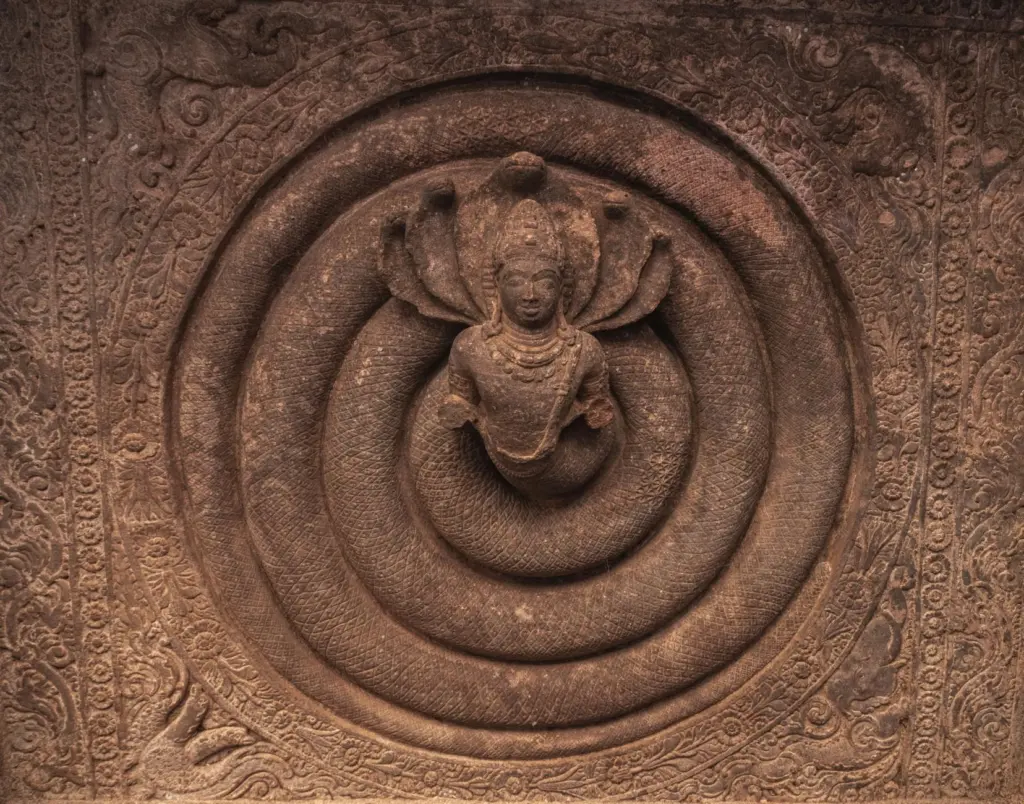
Jörmungandr is another child of Loki and Angrboða. Northlord’s account describes a serpent that grew until its body hugged the earth like a ring, so that it had to place its head on its tail. Routes North places it in the same position, encircling the world and lying beneath the oceans.
The image makes Jörmungandr a boundary figure. The world is surrounded by something that is both part of its shape and a danger to it. A reader should not take the serpent as a monster that lives in one particular sea; the sources describe it as encircling the whole world.
The misreading to avoid is the tidy ending. Northlord states that Jörmungandr is destined to meet Thor and that they will slay one another. Neither side walks away, which fits a story about fate more than a story about heroism. For anyone comparing tellings, this mutual destruction is the detail to check first.
Hel: ruler of the dead, not a villain
Hel is the figure most often mislabelled. Routes North identifies her as the ruler of the underworld Helheim, governing the fate of those who die from illness or old age. It adds that, rather than being evil, she is typically portrayed as a neutral figure presiding over the realm of the dead.
That distinction affects how the whole group should be read. Hel’s role is administrative and structural: someone has to preside over the dead, and the myths give the task to her. Placing her next to Fenrir and Jörmungandr under a single “monster” label flattens the difference between a being who threatens the order of the world and one who is part of it.
The practical advice for readers is simple. When a retelling calls Hel wicked, treat that as a later flourish rather than as the baseline description. The neutral portrayal is the one the overview gives as typical.
Níðhöggr and trolls: threats at the roots and edges
Níðhöggr at Yggdrasil
Níðhöggr works differently from the wolf and the serpent because it is fixed in place. According to Routes North, the roots of Yggdrasil are guarded by the dragon Níðhöggr, who constantly gnaws at its base. Nothing in that description is a journey or a battle. The dragon is a standing pressure on the structure of the world.
That makes Níðhöggr easy to overlook beside the dramatic final fights. It is worth keeping in view because it shows that monstrousness in this tradition can mean slow, constant damage as well as a single catastrophic event.
Trolls in remote places
Routes North describes trolls as ancient beings that dwell in remote landscapes, usually in cautionary or adversarial roles. The key word is landscape: trolls belong to the far places people did not live in, and their stories tend to mark what lies beyond the settled world.
This is also where the older layer of belief needs care. The same source separates Norse mythology, rooted in the pre-Christian beliefs of the Scandinavian people, from later local folklore influenced by Christianity. When a troll appears in a modern tale, it may belong to either tradition, so it should not be assumed to carry the same weight as Fenrir or Jörmungandr.
What monsters do in Ragnarök
In Ragnarök the monsters act as agents of a destined end, not as random attackers. Northlord notes that the Norns have predicted the death of Odin the Allfather, which will take place in Ragnarök. Routes North ties Fenrir to that death. Northlord adds that Jörmungandr is fated to meet Thor, with both dying.
Two practical conclusions follow from those accounts.
- The outcome is foretold. Because Odin’s death is predicted by the Norns, the monsters are carrying out something already settled, which is why the stories can treat them with a kind of grim inevitability.
- No clean victories. Thor and Jörmungandr slay one another, and Fenrir’s role in Odin’s death shows the gods paying a heavy price. The monsters do not need to win outright for the gods to lose something essential.
- Not every monster fights. Hel presides over the dead and Níðhöggr gnaws at the roots; the two represent the permanent structure of death and decay, not a battle role. Counting them as combatants misreads their place in the tradition.
Common misreadings and how to avoid them
Several habits distort how these beings are understood. Correcting them is mostly a matter of reading each figure in the role the myths give it.
- “All monsters are evil.” Hel is typically portrayed as neutral, and Níðhöggr’s gnawing is part of how Yggdrasil is described. Sort by function before judging morality.
- “Monsters are interchangeable.” A wolf that grows, a serpent that rings the world, a ruler of the dead and a dragon at the roots address different problems: containment, boundary, death and decay.
- “Every folklore creature is Norse myth.” Routes North separates pre-Christian Norse mythology from later Christian-influenced folklore, so a creature’s origin affects how much weight it deserves in a discussion of myth.
- “One retelling settles it.” Summaries differ in emphasis, and the pages cited here are not original texts. Checking details against what are called primary sources, as explained in the guide to what the term means, keeps small embellishments from hardening into fact.
Monsters are only part of the Norse picture, since the gods and the ways people guarded against danger complete it. For a deity on the other side of that divide, read Frey: The Vanir God Of Fertility, Kingship, And Sunshine — A Concise Guide (2026) – Scanheritage. For how Norse people sought protection from such dangers, see Viking Protection Symbols: Ancient Runes, Amulets, and How They Kept Warriors Safe – Scanheritage.
Frequently asked questions
| Question | Answer |
|---|---|
| What are the main Norse monsters? | The core group is Fenrir the wolf, Jörmungandr the world serpent, Hel the ruler of the dead and Níðhöggr the dragon at Yggdrasil’s roots. Trolls add a wider layer of beings tied to remote landscapes. |
| What role do monsters play in Ragnarök? | They help carry out a destined end. Fenrir is involved in Odin’s death, and Jörmungandr is fated to meet Thor, with the two slaying one another. |
| Is Hel an evil goddess? | Not typically. She is usually portrayed as a neutral figure who presides over Helheim and the dead who die from illness or old age. |
| Did Fenrir start out as a huge wolf? | Accounts describe him as a monstrous wolf who grows larger and stronger over time, and that growth is why the gods bind him. |