

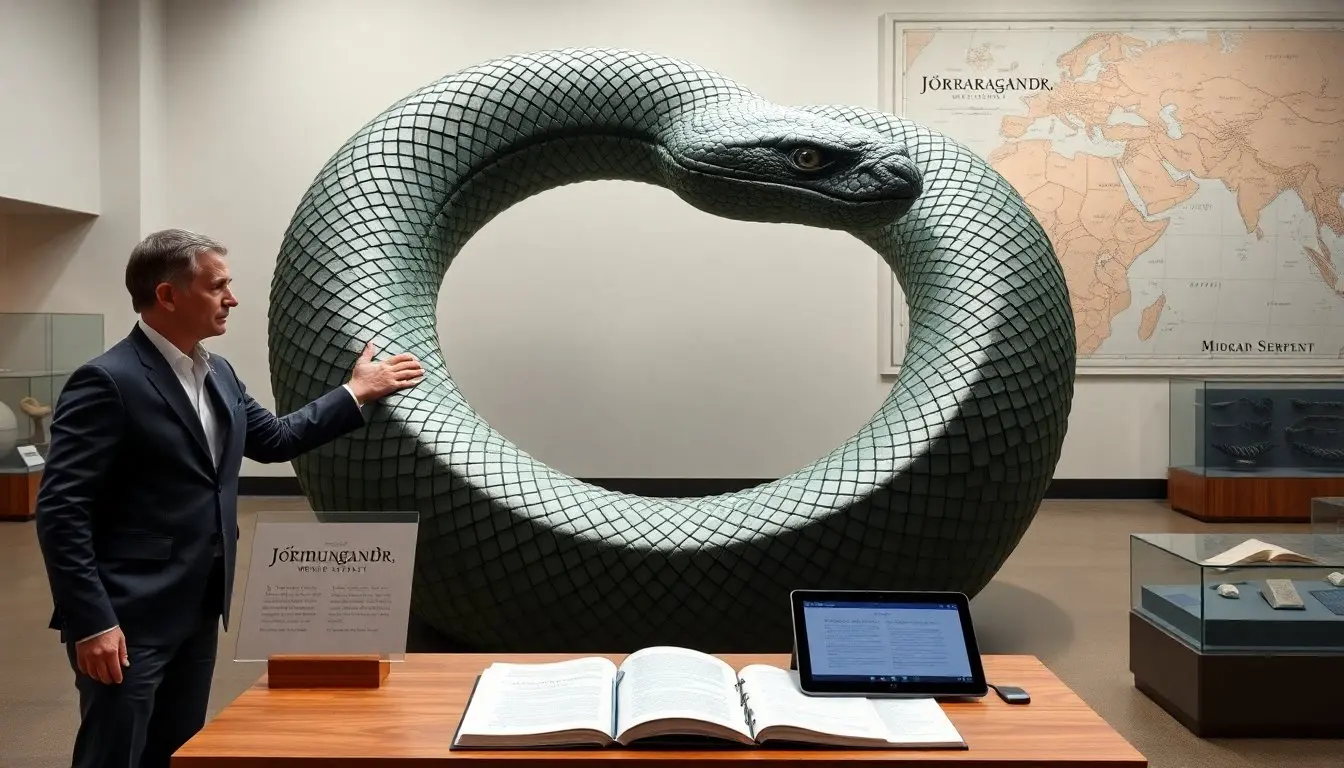
norse mythology jormungandr world serpent appears throughout the Old Norse literary corpus and in later scholarly and popular treatments. In those sources Jörmungandr is presented as a prodigiously large sea-serpent, the offspring of Loki and the giantess Angrboða, who is cast into the ocean by the gods and grows until it encircles Midgard. Far from a single, simple monster, Jörmungandr functions at multiple levels within Norse imagination: as a physical threat to sailors and gods, as a marker of the world’s limits, and as a symbol in cycles of danger and renewal. This introduction gathers the primary facts and signals the larger interpretive questions addressed below about origin, appearance, narrative roles in myth, the final confrontation at Ragnarök, and the creature’s continuing cultural legacy.
Key Takeaways
- Jormungandr, known as the world serpent in Norse mythology, is named in the Eddic materials as a child of Loki and Angrboða and grows until it encircles Midgard, marking the boundary between land and sea.
- The serpent stands for sea-power and danger, while also invoking cyclical, world-encircling imagery often visualized as the snake biting its own tail.
- Surviving myths present Jormungandr as both adversary and element of cosmic balance: its episodes with gods and seafarers prefigure the larger drama of Ragnarök.
- At Ragnarök the serpent and Thor are fated to clash; the encounter signifies both personal tragedy and cosmic transformation.
- Jormungandr continues to resonate in modern literature, visual culture, and scholarly debate, where it is used to explore themes from fate and apocalypse to ecological threat and cultural memory.
Origins And Lineage: Family, Birth, And Early Tales
In the Prose Edda and passages preserved in the Poetic Edda and skaldic tradition, Jörmungandr’s parentage is stated clearly: Loki and the giantess Angrboða bear three unusual children, of whom the serpent is one. The gods interpret these offspring as portents of danger and take preemptive measures: Odin casts the snake into the sea so it may no longer threaten the gods in Asgard. That simple narrative detail explains both the serpent’s marine habitat and its extraordinary growth. Early tales emphasize the gods’ attempts to control potentially disruptive powers, and the pathway from birth to banishment frames Jörmungandr as part of a wider pattern in Norse myth in which kinship and fate intersect. Modern scholarship frequently highlights how this familial origin ties the serpent to themes of liminality: born of a god associated with mischief and a giantess associated with the chaotic forces beyond the gods’ realm, Jörmungandr embodies a boundary figure that both threatens and defines the ordered world.
Appearance, Size, And Symbolism In Norse Cosmology
Descriptions in Old Norse poetry assert that Jörmungandr becomes so vast that it encircles Midgard, the world of humans. This image—often rendered in later art and commentary as the serpent surrounding the earth and sometimes biting its own tail—serves several symbolic functions. First, as a boundary marker it literalizes the edge of the human world: sea and depth are where the gods’ ordered realm meets chaotic forces. Second, the serpent’s size and marine domain link it to seafaring concerns familiar to Norse societies—storm, wreck, and the unpredictable power of the ocean. Third, the world-encircling motif resonates with a broader, cross-cultural iconography (the ringed or circular monster) that communicates cyclicality and containment; in Norse contexts this motif helps portray cosmic order as contingent and vulnerable. Artistic and archaeological echoes of large serpents and interlaced snake motifs on rune stones, metalwork, and ship carvings reinforce the creature’s resonances with protection, danger, and the sea, even when a direct depiction of Jörmungandr is not present.
Key Myths And Encounters
Surviving narratives preserve a number of notable episodes in which Jörmungandr figures prominently. One recurrent pattern is the confrontation with gods and heroes that both demonstrates the serpent’s power and sets dramatic stakes for later events: skaldic verses and saga prose record scenes of sea-storms, ominous signs to fishermen and sailors, and tense encounters that foreshadow the cataclysmic conflicts to come. The serpent functions narratively as an antagonist—its presence produces immediate danger—and as a mythic device that raises questions about fate and reciprocity between gods and giants. These accounts are often compressed or allusive in the sources, which leaves space for later retellings and artistic elaboration; in popular modern retellings the phrase norse mythology jormungandr world serpent recurs as shorthand for this dense cluster of images and episodes. Taken together, the myths show Jörmungandr occupying an ambiguous role: a primeval threat that, by its existence and actions, helps define the horizons of the Norse cosmological order.
Role In Ragnarok And The Serpent’s Cosmic Significance
Texts that describe the sequence of events at Ragnarök place Jörmungandr at the heart of the final struggle. The serpent’s release of its coils, the swelling of the seas, and the poisonous combat with Thor together form a concentrated moment of cosmic reversal: the boundary-marking creature becomes an instrument of dissolution. The narrative outcome is double-edged—although Thor kills the serpent, he is mortally wounded by its venom and dies shortly after, an exchange that underscores tragic reciprocity and the limited victory of the gods. Interpreters have read this scene in several ways: as evidence of a cyclical cosmic vision in which destruction is followed by renewal; as a mythic confirmation of fate and inevitable doom; and as an exemplum of the tragic heroism that characterizes many Norse narratives. The serpent’s role at Ragnarök therefore combines literal peril with profound symbolic force: it both precipitates and embodies the end of the present world-order and the conditions for whatever follows.
Cultural Legacy And Modern Interpretations
Jörmungandr’s image has persisted and evolved from medieval poetry to modern culture. Writers, artists, and filmmakers draw on the world-serpent motif to explore themes ranging from fate and apocalypse to environmental threat and maritime danger. In museum contexts, descriptions of Viking-age material culture sometimes invoke the serpent motif to help visitors connect decorative and symbolic patterns with the larger mythic world. Comparative scholars place Jörmungandr alongside other sea-serpent traditions to highlight shared human concerns about the ocean and the limits of knowledge, while literary and cultural critics read the serpent as a flexible symbol: a projection of collective anxiety, a narrative device for staging cosmic conflict, and a metaphor for cyclical time. Contemporary debates also consider ecological readings—seeing the serpent as an embodiment of the sea’s power and a figure useful for thinking about human relations to the environment—alongside psychological or structuralist accounts that emphasize mythic binaries and boundary figures. Because the basic narrative elements—the parentage, the banishment to the sea, the world-encircling growth, and the final combat with Thor—are repeated in both scholarly and popular texts, the phrase norse mythology jormungandr world serpent continues to serve as a concise entry point into a rich tradition of meaning and representation.