

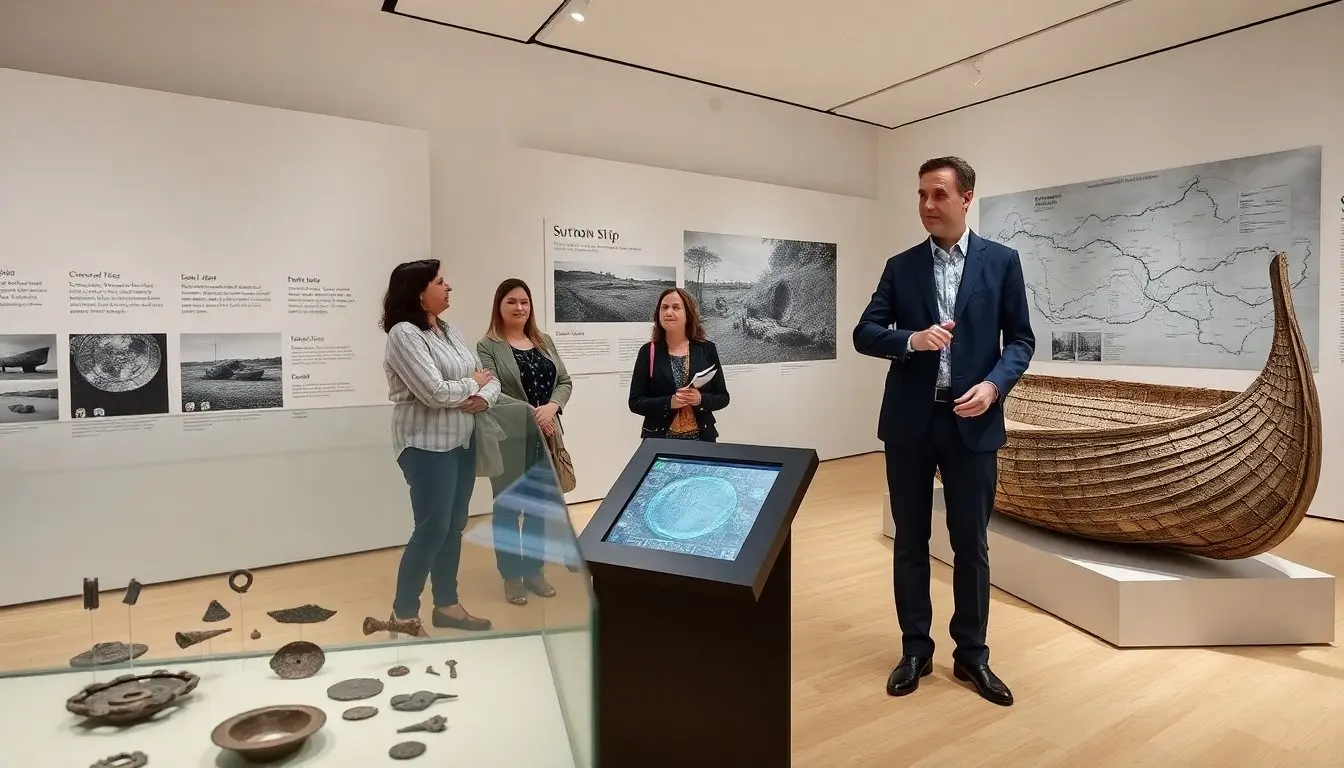
The sutton hoo ship now sits mainly as iron fragments, soil impressions, and extensive documentary records produced during and after the 1939 excavation. Although no intact timber survived the burial environment, the combination of metal fittings, rivet patterns, grave-goods, conservation records and later fieldwork has allowed archaeologists, conservators and interpreters to reconstruct the vessel’s form, context and significance. This article explains what happened to the original ship and its ironwork, where the finds are housed today, how they are preserved and interpreted, and what to expect when you visit the site and related displays in person.
Key Takeaways
- The Sutton Hoo ship now survives mainly as iron fragments and soil impressions; the original timber decayed long ago but left a clear archaeological trace.
- Careful conservation of iron fastenings, fittings and decorative metalwork made it possible to record the ship’s outline and to inform reconstructions and digital models.
- Major finds associated with the Sutton Hoo ship now are held across institutions — including national and local museums, archives and the National Trust — creating a network for research, loans and public display.
- The National Trust cares for the burial landscape and provides on-site interpretation that links objects in museums back to their original place of burial.
- Replicas, full-scale reconstructions, 3D visualisations and ongoing scientific work continue to refine understanding of the vessel, its construction and its wider cultural connections.
What Happened To The Original Ship And Its Ironwork
When archaeologists uncovered the sutton hoo ship now in 1939 they exposed a striking negative or soil impression where the hull once lay. Over centuries acidic soils, marine influence and biological decay removed the organic timber, leaving little or no wood in situ. Iron fastenings, nails, rivets, strapwork and fittings are far more resilient and thus survived in varying condition; these metal elements remained in the soil and preserved a fingerprint of the hull’s shape. During and after excavation conservators lifted these corroded iron pieces, cleaned and stabilised them, and documented their positions in detailed plans and photographs. The physical pattern of rivets and straps, together with the distribution of grave goods lying above the hull impression, enabled specialists to infer the ship’s length, type (a clinker-built vessel) and aspects of its construction. In short, the timber largely dissolved away, but the ironwork and the meticulous records made at excavation preserved the evidence needed to reconstruct the sutton hoo ship now for both scholarship and public interpretation.
Where The Ship Finds Are Housed Today: Museums, Archives, And The Site
Objects and documentation connected to the sutton hoo ship now are stewarded across several institutions so that they remain accessible for research and display. Major metalwork and key artifacts are held by national museums, while the National Trust manages the burial mounds and on-site interpretation. Local county museums and university departments keep smaller finds, field records, casts and replicas that support teaching and outreach. Professional archives store original excavation notebooks, measured drawings, conservation reports and large-format photographs; many of these have been digitised to support remote research. Museums commonly loan objects to each other for temporary exhibitions, and conservation laboratories coordinate long-term treatment and monitoring. This distributed approach — combining museum galleries, research archives and the protected landscape — means the story of the sutton hoo ship now is available in multiple settings: in curated display cases, in specialist reading rooms, and in the place it was discovered.
How The Ship Is Preserved And Interpreted For Visitors
Conservation teams keep the sutton hoo ship now assemblage under controlled conditions to slow ongoing deterioration. Metal objects are stored and displayed in cabinets that regulate humidity, temperature and light levels; they are periodically assessed for corrosion and re-treated if needed. Curators create gallery displays that combine original objects with explanatory labels, measured drawings, casts of the grave impression and photographs from the excavation to make the evidence accessible to non-specialists. Interpretive programmes explain both the firm findings and the uncertainties: how rivet patterns inform hull shape, how grave goods help date the burial, and where scholarly debates remain open. Museums increasingly use 3D visualisations, touchable replicas and scale timbers so visitors can appreciate the ship’s size and construction without exposing fragile originals to handling. Educational material and guided tours place the burial in wider historical contexts — trade networks, craft technology, and early medieval society — helping people connect the physical finds to human stories.
Seeing Sutton Hoo In Person: The National Trust Site And On‑Site Displays
The sutton hoo ship now can be experienced in two complementary ways: through the objects curated in museums and through visiting the burial landscape itself. The National Trust operates a visitor centre close to the mound complex where panels, replicas and audiovisual displays explain the 1939 excavation, subsequent research and how archaeologists interpreted the soil impression as a ship burial. Paths around the mounds give sightlines across the river valley and coastline that contextualise why a ship burial would have been placed here. On-site interpretation is designed to link the artefacts people see in museum cases back to the field evidence and the place they were found; staff, volunteers and seasonal programmes offer guided walks, talks and family activities that emphasise the local landscape, conservation work and ongoing research. Practical visitor information — opening times, access routes and facilities — is provided by the National Trust so people can plan a visit that combines museum galleries with the on-site experience of the sutton hoo ship now and its setting.
Replicas, Reconstructions, And Ongoing Research
Replica Builds, Digital Models, And Current Excavation Projects
To make the sutton hoo ship now more tangible, craftspeople and archaeologists have produced a variety of replicas and reconstructions informed by the surviving ironwork and excavation records. Full-scale and partial timber reconstructions, together with scaled models and life-size timbers, allow practical testing of building techniques and provide compelling displays. Digital reconstructions and 3D scans of individual finds are shared with researchers and the public, enabling interactive viewing and comparative study without risking delicate originals. Ongoing scientific work — from non‑destructive imaging to materials analysis and soil science — continues to refine understanding of construction methods, corrosion processes and burial context. Field projects nearby use geophysical survey, targeted test trenches and environmental sampling to sharpen interpretations of the landscape and to check for related features. Publication of results in museum reports and academic journals, plus regular updates to displays and educational programmes, ensure that knowledge about the sutton hoo ship now remains active: new methods and fresh evidence steadily improve how the vessel and its cultural world are presented to both specialists and general audiences.