

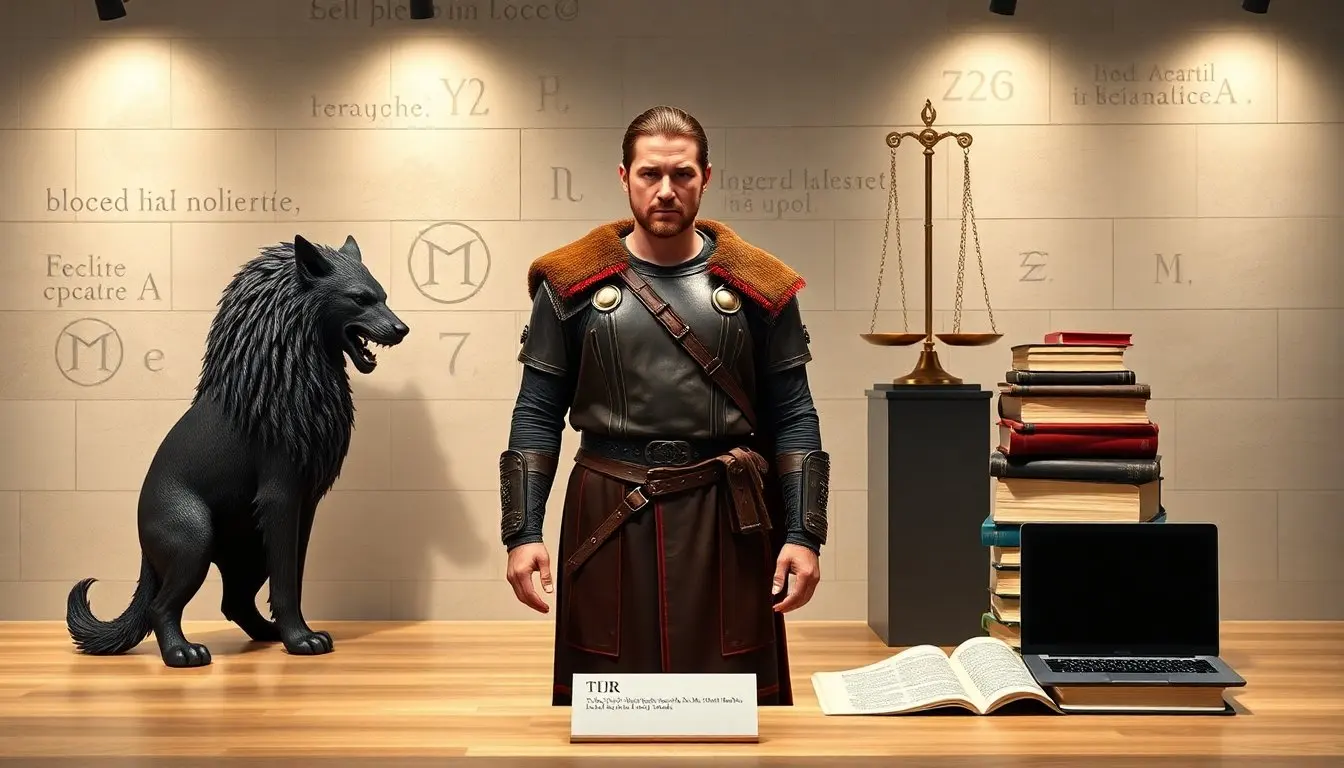
tyr norse mythology appears in the first lines of many Old Norse poems. The name signals a god who acts for law and order. This guide explains his origin, main roles, key myth, and cultural traces. It uses clear facts and brief examples. The text stays direct and simple to help readers learn about tyr norse mythology quickly.
Key Takeaways
- Týr in Norse mythology is a god symbolizing law, order, and honor, often invoked in war and legal oaths.
- His name derives from Proto-Germanic *Tiwaz and is the origin of the weekday name Tuesday.
- Týr is famous for his sacrifice of losing his right hand to the wolf Fenrir to bind the beast with a magical chain.
- He represents public order and male honor, contrasting with gods seeking personal glory.
- Historical texts and archaeological finds link Týr to war, law, and oath-keeping in early Germanic societies.
- Modern studies of tyr Norse mythology rely on poems, inscriptions, and medieval writings that highlight his legal and martial roles.
Origins, Name, and Historical Context
Scholars link the name Týr to Proto-Germanic *Tiwaz. The element *Tiwaz appears across West Germanic and North Germanic languages (Old English Tīw, Old Norse Týr), and it is the etymological source of modern English Tuesday. Linguists note a possible, debated connection with older Indo‑European theonyms for sky or daylight, a line of argument used to explain how a war‑and‑law figure might derive from an earlier sky or deity archetype; this remains a subject of scholarly discussion rather than settled fact.
Evidence for Týr’s historical presence comes from several kinds of sources. The two main medieval compilations— the Poetic Edda and Snorri Sturluson’s Prose Edda—refer to Týr directly or indirectly. Roman and late antique authors sometimes equated Germanic deities with Roman ones (an interpretatio romana that links Týr with Mars in a handful of geographic and glossing notes), and short runic inscriptions and migration‑period bracteates have been interpreted by many scholars as possible references to *Tiwaz. Place‑names and the survival of the weekday name further support a long cultural memory. Taken together, linguistic, textual, and material traces make a consistent picture: tyr norse mythology represents a deity whose importance lay in public functions—especially legal order and the communal aspects of warfare—rather than private cultic display.
Týr’s Roles: Law, Oaths, War, and Honor
Across the surviving corpus, Týr is most consistently associated with formal social bonds: law, oaths, and the obligations that tie communities together. Poetic diction and skaldic kennings sometimes invoke him in contexts of binding, judgment, and the upholding of compacts. In narrative sources his character is portrayed as level‑headed and willing to accept sacrifice for the sake of a greater legal good. This emphasis on the public and procedural dimensions of authority distinguishes him from gods who are chiefly valorous or acquisitive.
Practices connected to Týr in the sources include oath‑swearing at assemblies and invocation in the context of warfare when the maintenance of order or an oath was at stake. Legal assemblies (things) in early Germanic societies depended on shared symbolic authorities to guarantee compliance; historians reconstruct that a figure like Týr would have been a natural emblem for that function. Militarily, poets and lists of gods place him among those invoked by warriors, and his persona combines courage with restraint: he is valorous, but his bravery is expressed through duty, not boastful pursuit of personal glory. Modern summaries that use the phrase tyr norse mythology typically highlight this mix of legal, martial, and honorific associations.
The Fenrir Myth: How Týr Lost His Hand
The best‑known myth about Týr is the Fenrir episode, preserved most fully in the Prose Edda. The gods decide the giant wolf Fenrir is too dangerous and attempt to bind him. After testing ordinary fetters with no success, they commission the magical rope Gleipnir, crafted from a set of paradoxical ingredients listed by Snorri (elements like the sound of a cat’s footfall and similar mythic substances). Fenrir refuses to be bound unless one of the gods places a hand in his mouth as a pledge of good faith. Týr volunteers, and when Fenrir discovers he cannot break Gleipnir he bites off Týr’s right hand. The gods leave Fenrir bound until Ragnarök, when the wolf will break free.
This episode functions on several levels: as an etiological myth explaining Týr’s missing hand, as a dramatic instance of sacrificial obligation for communal safety, and as a narrative that highlights Týr’s unique moral stance among the gods. Poets and commentators often cite this story when discussing tyr norse mythology because it encapsulates his role as a guarantor of order willing to pay a high personal price.
Other Key Myths and Literary Sources
Týr is mentioned more sparsely than some other deities, but those mentions are instructive. The Poetic Edda contains indirect references and kennings that link him to warfare and law; Snorri places him among the principal Aesir in his systematic accounts; and skaldic verse can invoke him in concise poetic formulas. Outside the Eddas, runic inscriptions and certain migration‑period artifacts (notably some bracteates) are read by many scholars as preserving traces of a worship or cultic memory of *Tiwaz. Medieval chroniclers and later folkloric materials preserve echoes of oath practices and of a god associated with binding promises.
Modern scholarship treats these scattered attestations collectively: rather than a detailed personal mythology like Odin’s or Thor’s, Týr’s profile is assembled from functional references across genres—poetry, law lists, etymology, and archaeology. That approach explains why tyr norse mythology is often discussed as a theme (law and honor) more than as a large cycle of narratives. Contemporary interest also notes Týr’s afterlife in place‑names, weekday names, and in modern cultural receptions where he is sometimes invoked as an emblem of law, duty, and constrained courage.