

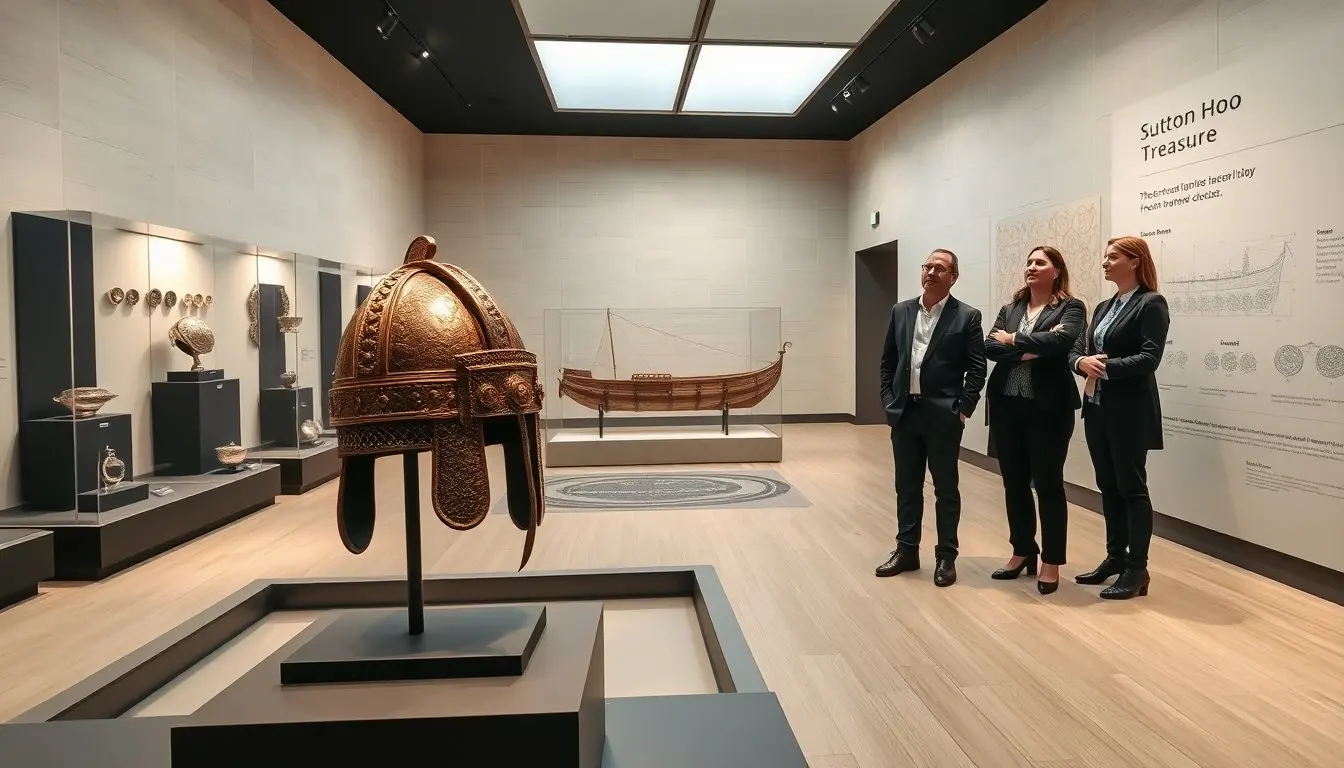
sutton hoo treasure changed how scholars view early medieval England. The find contained a ship burial, metalwork, and personal items. It showed craft links across Europe and beyond. This guide summarizes what the site contained, who excavated it, the key objects, what those objects tell historians, and how visitors can see the finds today.
Key Takeaways
- The Sutton Hoo treasure transformed understanding of early medieval England through its rich ship burial and artifacts.
- Discovered in 1939 by Edith Pretty and archaeologist Basil Brown, the site includes elite grave goods showing high craftsmanship and symbolic imagery.
- Iconic objects like the Sutton Hoo helmet reveal elite status and martial identity linked to wider European and Byzantine connections.
- The ship burial and associated artifacts highlight social hierarchy, trade networks, and cultural exchange during the Anglo-Saxon period.
- Today, visitors can explore the Sutton Hoo site and museum exhibits managed by English Heritage, offering insights into the treasure’s historical context.
What Was Found At Sutton Hoo — The Hoard, Burials, And Site Layout
Archaeologists found a group of burial mounds on a Suffolk headland. They recorded one large ship grave and several smaller burials. The main deposit held metalwork, weapons, silverware, and personal items. The team also found pot fragments and textiles traces. The layout showed a focus on one elite burial surrounded by supporting graves. The sutton hoo treasure items appeared arranged as grave goods to mark rank. The site plan suggested ritual use of the landscape and visual links to river routes.
Beyond the headline objects, careful excavation revealed subtle evidence: postholes, rivet patterns from the buried ship, and concentrations of organic residues that hint at food, drink and perishable goods once laid in the grave. The smaller satellite burials and ring ditches demonstrate that the burial ground was used over generations, which helps archaeologists interpret changing funerary practices and local power structures.
The 1939 Discovery, Excavation, And The People Behind It
A landowner called Edith Pretty first reported the mounds. She hired a local archaeologist who invited experts to the site. Excavations began in 1939 and paused for war. Key figures included Basil Brown and later staff from the British Museum. They recorded the ship impression and recovered metal fragments. Conservators later reconstructed the metalwork. The sutton hoo treasure reached the public through museum displays and press reports. The team kept careful notes and sketches that later researchers used to re-evaluate the finds.
The work combined careful field recording with the practical challenges of wartime Britain: limited manpower, transport constraints and the need to stabilise fragile materials immediately. Photographs, measured plans and detailed diaries made during the original excavation have been invaluable for later conservation and reinterpretation. Over subsequent decades, new scientific techniques — for example, soil analysis and metal conservation methods — have allowed specialists to extract further information from the surviving material and from the archaeological context recorded in 1939.
Iconic Objects From The Hoard And Why They Matter
The collection included decorated weapons, silver bowls, and gold fittings. These objects showed a mix of local and imported styles. The metalwork displayed high craftsmanship and symbolic imagery. They suggested ties to Scandinavia and the Byzantine world. The sutton hoo treasure items gave scholars new evidence about wealth display and political power. The finds also offered material for study of early medieval metallurgy and artistic networks across Europe.
Studying the objects reveals multiple layers of meaning: technical skill in alloys and joining techniques, workshop traditions shared across regions, and iconography that communicates rank, religious ideas and identity. The presence of objects that incorporate foreign design elements indicates that the burial’s owner or his retinue participated in long-distance exchange networks, whether through trade, diplomacy or gift-giving.
The Sutton Hoo Helmet — Design, Symbolism, And Reconstruction
Conservators reassembled fragments into a near-complete helmet. The helmet features face mask plates, cheek guards, and decorative bands. Craftsmen hammered and inlaid the metal to form animal and warrior motifs. Scholars read the imagery as a claim to status and martial identity. The sutton hoo treasure helmet helped reshape ideas about elite display in early England. Museum visitors often call it the most dramatic single item from the site.
Its reconstruction was both a technical and interpretative project: conservators had to stabilise fragile iron and conserve thin gold leaf while curators decided how to present the helmet in ways that explain both its original function and its symbolic power. As an artefact it demonstrates how personal armour could communicate leadership, ancestry and access to exotic materials or motifs, and it remains central to discussions about identity and rulership in the period.
The Ship Burial And Other Standout Artifacts
The main grave contained a ship impression nine meters long. The ship acted as a burial container and a prestige marker. Excavators found shields, a purse lid, and a lacquered box. Silver bowls and drinking horns suggested feasting and gift exchange. Many items showed repair marks, which suggested long use. The sutton hoo treasure ship offered a clear link between burial practice and social display in this period. The ship impression also preserved a record of ship construction and burial layout.
Items such as the decorated purse lid and a set of patterned shoulder clasps illustrate both technical virtuosity and a carefully curated selection of objects intended to communicate the buried individual’s role and connections. The ship itself, while not preserved as timber, left a pattern of rivets and iron fittings that have informed maritime archaeologists about hull form, fastening techniques and how ships could be used as funerary containers in northern Europe at this time.
What The Treasure Reveals About Anglo‑Saxon Society And Connections
The finds indicate a hierarchical society with elite display. Leaders used imported goods to show status. The metalwork styles link craftsmen across the North Sea and the Mediterranean. The sutton hoo treasure demonstrates active trade and gift networks. The objects also show literacy and symbolic references to power. They suggest that leaders adopted visual language from other cultures while keeping local traditions. Historians now use the finds to map political ties and cultural exchange in the sixth and seventh centuries.
In practice, the assemblage provides evidence for several interrelated themes: how elites consolidated power through display and ritual; how material culture circulated across regions; and how funerary rites incorporated performance, consumption and memory. Researchers combine the artefacts with documentary sources and comparative archaeology to build models of early Anglo‑Saxon polities, economy and cultural interaction, showing that this was a dynamic era of shifting alliances and creative appropriation of foreign forms.
Visiting Sutton Hoo Today — Museum Displays, Site Highlights, And Practical Tips
English Heritage manages the site and a visitor center near Woodbridge. The center displays many sutton hoo treasure objects, including replicas and the helmet reconstruction. Staff show the ship outlines and explain the excavations. Visitors can walk the mounds and view the river setting. The center sells guidebooks and offers timed entry. Travelers should book ahead in peak months. They should allow time for both the gallery and the outdoor trail. Photography rules vary, so visitors should check current guidance before they arrive.
When planning a visit, allow time for the indoor displays where labels and interactive panels explain context, conservation and excavation history, and for the outdoor trail where interpretation boards place the mounds in the landscape. Wear sturdy footwear for uneven ground, bring weather gear for the exposed headland, and check opening times in advance. Those interested in deeper study should consult museum publications and local archives for excavation reports and later research summaries that expand on the lift the sutton hoo treasure has given to understanding early medieval England.