

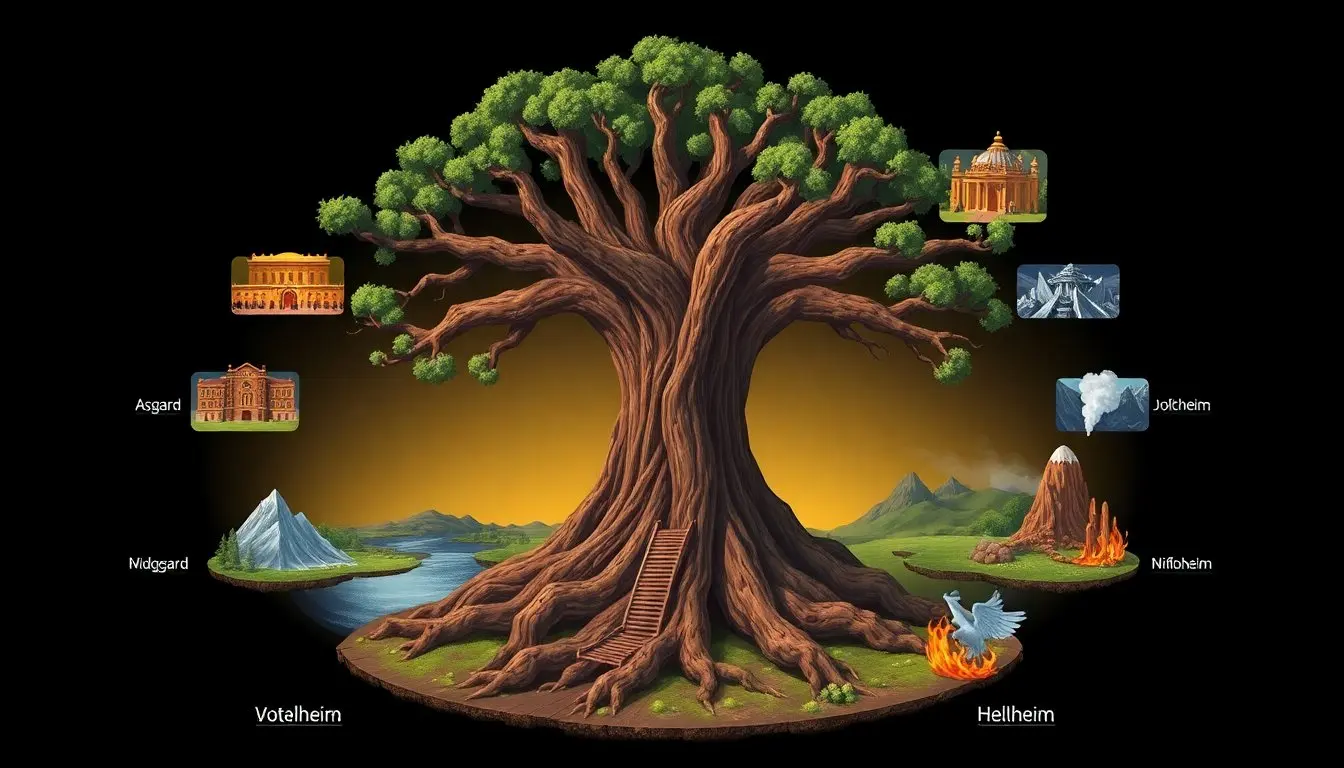
what are the nine realms in norse mythology appears first to provide context. The question asks which worlds surround Yggdrasil and who lives in each. This guide lists each realm and gives key traits. The guide keeps language simple and direct. It helps readers learn names, rulers, and basic roles without extra detail.
Key Takeaways
- The nine realms in Norse mythology are interconnected worlds surrounding the cosmic tree Yggdrasil, each inhabited by distinct beings and forces.
- Asgard, Midgard, and Vanaheim represent the realms of the Aesir gods, humans, and Vanir gods, highlighting divine governance and human existence.
- Jotunheim houses giants, symbolizing raw power and opposition to gods, while Muspelheim and Niflheim embody elemental realms of fire and ice, balancing creation and destruction.
- Yggdrasil links the nine realms through its roots and branches, serving as a cosmic structure that allows passage between these worlds.
- Understanding the nine realms helps clarify the relationships and conflicts in Norse mythology, emphasizing their roles in myth cycles and cosmic balance.
How Yggdrasil Connects The Nine Realms
Yggdrasil forms the cosmic ash tree that links the nine realms. The tree holds roots and branches that reach each realm. Poetic sources place roots in wells and courts that belong to different beings. The tree gives structure. It gives a visual way to imagine how the worlds sit near one another.
Scholars and myth tellers describe three main roots. One root reaches a well tended by the Norns. One root reaches a spring where a serpent or dragon lives. One root reaches the realm of the gods. The tree stands at the center and it holds paths and bridges. Travelers cross those paths to move between realms in stories.
The term “the nine realms” appears in later summaries of Norse myth. The phrase names the distinct world-spaces around Yggdrasil. People use the phrase to group Asgard, Midgard, and the other worlds. The term helps modern readers ask: what are the nine realms in Norse mythology and how do they relate?
Realms Of Gods And Humans: Asgard, Midgard, Vanaheim
Asgard hosts the Aesir gods. Odin leads a council there. Asgard holds halls for warriors, feasting, and counsel. Myth shows Asgard as high and protected. Writers often place a rainbow bridge, Bifrost, as a link between Asgard and Midgard.
Midgard hosts humans. People live, work, and die in Midgard. The world sits near the center of Yggdrasil. The gods protect Midgard and they quarrel over human affairs. Many tales show gods visiting or testing people in Midgard.
Vanaheim hosts the Vanir gods. These gods rule fertility, wealth, and nature. Vanaheim differs from Asgard in mood and focus. The Aesir and Vanir once fought a war and then exchanged hostages. That exchange shows ties between Asgard and Vanaheim.
When readers ask what are the nine realms in Norse mythology, these three often appear first. They represent divine rule, human life, and another divine family. Each realm plays a role in myth cycles and poems.
Giants, Fire, And Ice: Jotunheim, Muspelheim, Niflheim
Jotunheim hosts the giants. Giants live in mountains and wild places. They oppose the gods in many tales and they sometimes form alliances through marriage. Jotunheim presents raw force and old powers.
Muspelheim hosts fire and a prime fire being. A fire giant or lord rules there in some accounts. The realm gives heat and flame that act in creation myths and in end-time tales. Flames from Muspelheim appear in descriptions of world-changing battles.
Niflheim hosts fog, cold, and deep wells. The realm holds icy rivers and a well that links to the origins of life and death in some poems. Niflheim often contrasts Muspelheim. Frost and steam meet and cause change in the first ages of myth.
Readers who ask what are the nine realms in Norse mythology find these three form natural opposites. Fire, ice, and giant-lands create conflict and balance across stories.
Remaining Realms: Alfheim, Svartalfheim (Nidavellir), Hel
Alfheim is the realm associated with the light elves. In surviving sources it is described as a bright, graceful place whose inhabitants—elves—are linked with fertility, gifts, and subtle aid to humans. Some texts name Freyr as a ruler or patron associated with Alfheim. In stories, elves can be helpful or distant, and their realm adds a gentler, liminal space to the world-map around Yggdrasil.
Svartalfheim (sometimes identified with Nidavellir in later retellings) is the realm of craftsmen, smiths, and underground beings often called dwarves or dark elves. This realm supplies many of the gods’ magical items—fine weapons, treasures, and tools—made by expert hands. The smithing culture of Svartalfheim explains how objects like famed swords and amulets enter myth narratives.
Hel (often called Helheim) is the realm of the dead that receive those who die of illness or old age. Ruled by a being also named Hel in the sources, this place is not identical with the heroic halls taken by warriors but is a necessary part of the cosmology. It occupies a lower or inward region in the Yggdrasil model and links ideas of fate, decline, and the afterlife in Norse thought.
Put together, Alfheim, Svartalfheim, and Hel complete the ninefold map readers expect when asking: what are the nine realms in Norse mythology. Each provides a distinct social and metaphysical role—light elves, underground craftsmen, and the common dead—so that the full picture balances gods, humans, giants, elemental forces, and the spirits of the dead.
Travel, Authority, And Sources
Stories show different ways to move or interact between realms: bridges like Bifrost, secret passages, journeys by boat, or magical travel by the gods and chosen mortals. Authority and overlap are common themes: gods claim protection over Midgard, giants contest divine plans, and smiths or elves supply objects that change fate.
Our knowledge of the nine realms comes mainly from Old Norse writings compiled in the Poetic Edda and the Prose Edda, along with later medieval sources and folk material. Those texts preserve names, brief descriptions, and narrative roles, but they do not present a single, consistent map. Modern summaries use the nine-realms phrase to gather the most frequently named spheres into one helpful list.
When readers ask what are the nine realms in Norse mythology, the practical answer is to name and briefly describe each realm, note its typical inhabitants and ruler-figures, and explain how Yggdrasil functions as the connecting structure. That approach helps make sense of many myths and shows why the nine realms remain a useful way to think about Norse cosmology.