

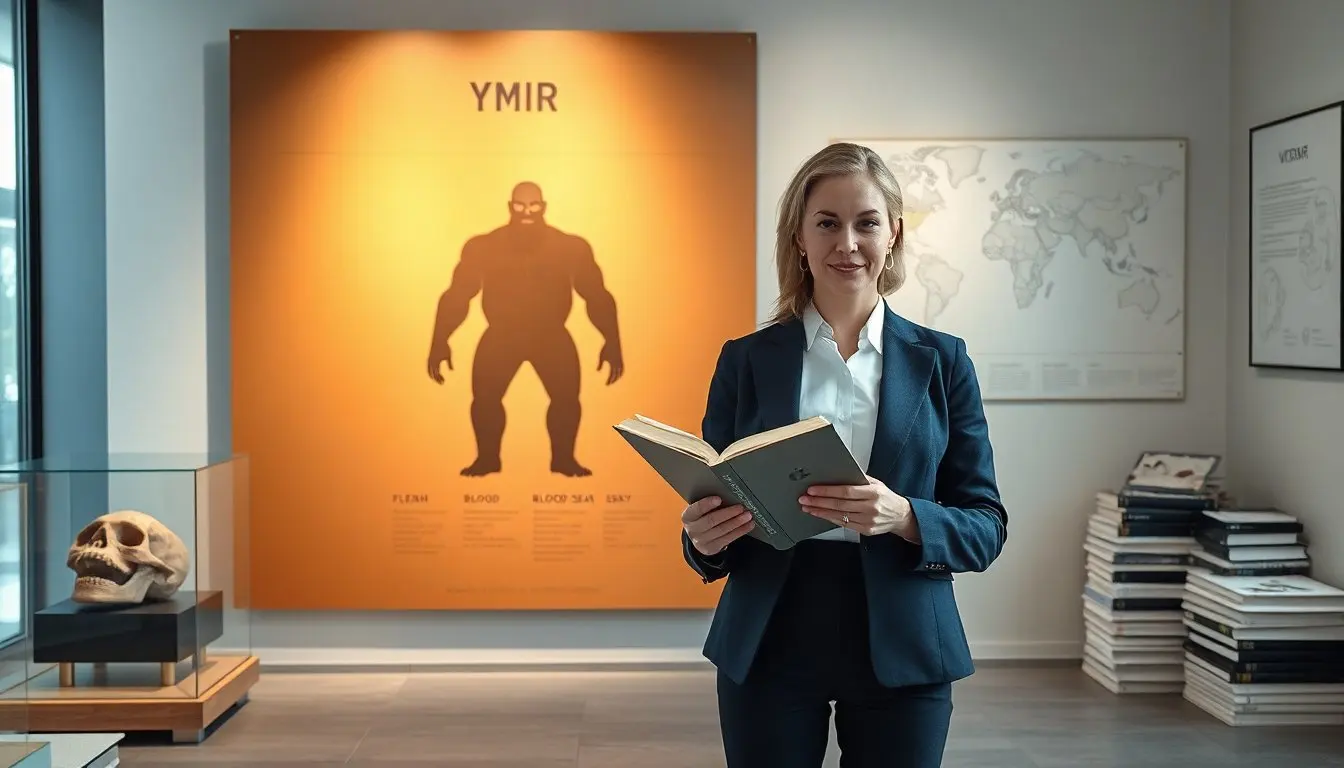
Ymir norse mythology appears as the primeval giant who begins creation in Norse texts. Scholars treat Ymir norse mythology as central to Old Norse cosmogony: his death and dismemberment explain both physical features of the world and the ordering act that separates chaos from cosmos. This guide outlines Ymir norse mythology origins, his role in the larger creation narrative, the decisive slaying by the Aesir, how the two main medieval collections preserve the tale, and the figure’s continuing cultural legacy. The aim is to give readers a fuller, contextualized account of Ymir norse mythology without oversimplification.
Key Takeaways
- Ymir in Norse mythology is the primeval giant whose body forms the cosmos, central to Old Norse creation stories.
- Ymir originated from elemental forces, born when fire and ice met in the void of Ginnungagap.
- Odin and his brothers killed Ymir, using his body parts to create the earth, sea, sky, and other world features.
- The Poetic Edda and Prose Edda present complementary but distinct versions of Ymir’s story, enriching its understanding.
- Ymir symbolizes chaos transformed into order through divine sacrifice, a theme common in world creation myths.
- Ymir’s story continues to influence art, literature, and modern media, highlighting the myth’s enduring cultural impact.
Origins Of Ymir: Birth From Fire And Ice
In accounts preserved in the Poetic Edda and the Prose Edda, the origin of Ymir norse mythology is placed at the interface of elemental extremes. Before the world existed there was Ginnungagap, a yawning void. To one side lay the cold and fog of Niflheim, to the other the heat and sparks of Muspelheim. When the hot and cold met, drops formed and gave rise to a living being the sources call Ymir. This origin story emphasizes natural processes—melting, condensation, spontaneous life—rather than a planned procreation by an existing god.
Medieval authors describe Ymir as enormous, slow-moving, and capable of generating further giants without sexual coupling in the way modern readers expect: one image has him sweating and producing offspring, another describes a hermaphroditic capacity. These images together suggest that Ymir embodies the raw materiality from which the cosmos is later carved: an ungainly, aqueous mass whose internal potency stands in contrast to the structured world the gods establish. Scholars treat these motif clusters—void, elemental collision, spontaneous generation—as part of a broader Northern European repertoire of cosmogonic imagery.
Ymir’s Role In Cosmogony: From Chaos To The Nine Worlds
Ymir norse mythology functions as the narrative hinge between pre-cosmic chaos and the ordered universe of the nine worlds. In the mythic sequence, Ymir’s existence represents a precondition in which distinct realms are not yet separated. The dramatic transition occurs when the younger generation of divine beings—proto-gods who are active, creative, and law-giving—bring about a restructuring of reality.
After Ymir’s death, his body is divided and rearranged to form discrete parts of the new world: land, sea, sky, mountains, and living features are articulated from a single organic source. The clearing of space and the creation of boundaries—earth from flesh, waters from blood, sky from skull—produce an ordered cosmos capable of supporting distinct realms such as Midgard, Asgard, and the others traditionally counted among the nine worlds. Thus Ymir norse mythology supplies an etiological explanation for why the world has separable domains and why those domains are intelligible and interconnected.
The Slaying Of Ymir: Odin, Vili, And Vé’s Creation Act
The decisive moment in the narrative is the slaying of Ymir by Odin, Vili, and Vé (names that appear in the Prose Edda). In the versions that survive, the killing is not merely punitive but constitutive: by administering violence to the primeval giant the gods transform raw potential into ordered reality. The act grants the gods both the materials of the world and the moral authority to govern it.
Conservative readings emphasize the necessity of this violence as a creative strategy in a hostile environment; interpretive approaches that focus on ritual and sacral kingship read the episode as enacting a foundational sacrifice that legitimates social order. The narrative also contains practical cosmological moves—the hauling of Ymir’s body, the measuring and fixing of his skull as a vault, and the placement of his bones as mountains—that together perform the transition from an amorphous whole to a constructed, inhabitable world.
Body Parts As World Parts: How Ymir Became Earth, Sea, And Sky
The mapping of Ymir’s anatomy onto familiar geographic features is strikingly concrete in both Eddic corpora. Flesh becomes soil and plains; blood becomes the seas and rivers; bones become mountain ranges; teeth and bone fragments become stones and pebbles; hair becomes vegetation; skull becomes the dome of the sky; and the brain is sometimes described as clouds or atmospheric vapor. These correspondences operate both poetically and etiologically: they supply memorable imagery while explaining natural phenomena by reference to a single mythical event.
Because the transformation is literal in the texts, readers are encouraged to imagine the world as literally assembled from a once-living being. This lends a moral and relational texture to the landscape—rock and river are not inert things but parts of a primordial body—an idea that has philosophical and religious resonance across many cultures and helps account for the persistence of Ymir norse mythology as a motif for thinking about nature and ancestry.
Ymir In The Poetic Edda And Prose Edda: Key Passages And Differences
The Poetic Edda and the Prose Edda are our principal medieval witnesses for Ymir norse mythology, but they approach the material differently. The Poetic Edda preserves older, fragmentary verses that present images and lines of argument with compressions and ellipses; its poetry often assumes a knowledgeable audience that can supply background. The Prose Edda, composed by Snorri Sturluson, retells and systematizes many of these motifs in a prose framework intended to instruct skalds and readers in mythic lore and poetic diction.
Because Snorri arranges episodes into a clearer narrative arc, his version supplies names and connections that help fill out the picture found in the older verses. Conversely, the Poetic Edda preserves archaic turns of phrase and associations that can be lost when rendered into prose. Comparative reading of both sources reveals differences of emphasis—Snorri’s rationalizing tendencies versus the poetic text’s dense, image-rich style—and invites debate about what aspects of Ymir norse mythology reflect genuinely ancient folk belief and which reflect medieval literary shaping.
Ymir’s Symbolism And Interpretations: Giant, Chaos, And Cosmic Sacrifice
Scholars and commentators offer multiple, sometimes competing, interpretations of Ymir norse mythology. One common reading sees Ymir as a symbol of primordial chaos or undifferentiated matter that must be overcome for order to arise. Another emphasizes the motif of cosmic sacrifice—whereby a slain being’s body becomes the cosmos—which links the Ymir story to a wider international theme in comparative mythology.
Other approaches stress local cultural meanings: readings focused on ritual, landscape sacralization, or the social logic of kingship see the myth as an imaginative technology for claiming possession and ordering the environment. Literary and anthropological treatments also register ambivalence in the myth—Ymir is both progenitor and enemy, source and corpse—so analyses frequently probe how Norse thought negotiates origins, violence, and authority in a harsh northern world.
Ymir’s Legacy In Art, Literature, And Modern Culture
Ymir norse mythology has left an extended afterlife in visual and verbal culture. In the medieval period the tale is echoed in carved stone, manuscript illustration, and poetic allusion. In later centuries the image of a world fashioned from a giant’s body recurs in literature and the visual arts when authors and artists wish to evoke deep time, primordial violence, or an origin that is bodily and organic rather than mechanistic.
In modern popular culture Ymir norse mythology continues to furnish evocative material for fantasy fiction, comics, film, and games; creators draw on the scale and drama of the myth to stage scenes of creation, catastrophe, or the uncanny. At the same time contemporary scholarship and museum displays have brought renewed attention to the sources themselves, encouraging nuanced readings that respect both the literariness of the Eddic texts and the myth’s power as a cultural symbol. The persistence of Ymir norse mythology across media and centuries attests to its capacity to speak to questions about origin, belonging, and the relation between violence and order.